Is Joshua Tree Worth The Drive From Palm Springs?
A straight answer on whether Joshua Tree National Park is worth the drive from Palm Springs, with tour prices, self-drive costs, and who each option suits best.
Is Joshua Tree Worth The Drive From Palm Springs?
Yes, for most travellers the drive is worth it, and the deciding factor is what you want from the day. Joshua Tree National Park is a landscape of stacked granite boulders and namesake trees that exists nowhere else at this scale within reach of a resort city, and the park charges just $30 per private vehicle for a 7-day pass, with the drive itself about an hour each way. If you would rather see the park from behind the wheel, our guide to touring Joshua Tree without leaving your car explains which roads allow it and what a windscreen-only visit misses.
The doubt is understandable. Palm Springs sells ease: golf courses, mid-century architecture, tram rides, and a walkable downtown. Joshua Tree sells the opposite. There is no gas station, no restaurant, no grocery store, and no water in the park interior, and cell reception is very limited. You leave a city built for comfort and enter a desert that makes no concessions. That contrast is exactly why the drive rewards the right traveller. If you're wondering whether that contrast fits into a single outing, our honest verdict on Joshua Tree as a day trip covers the drive itself, tour costs, and who should plan to stay overnight instead.
The park spans elevations from 536 ft to 5,814 ft at Quail Mountain, and the scenery changes with every mile of climbing road. What starts as sandy flats dotted with creosote becomes a forest of Joshua trees wedged between house-sized boulders, then opens into the vast Pinto Basin. A single drive through the park covers terrain that feels like three different deserts. That variety is what people remember, and it is what the hour of highway buys.
There is also a practical middle path that removes the doubt entirely. Several guided tours depart from the Palm Springs area, including the Backroads Hummer H2 Tour from $159 per person, rated 4.7 across 595 reviews, which includes park admission. That option converts the drive itself into part of the experience, with a guide handling commentary, route, and timing. We compared the main options below, and the trio here covers the three most common ways Palm Springs travellers do this day.
Can You Do A Day Trip To Joshua Tree From Palm Springs?
Yes, a day trip to Joshua Tree from Palm Springs is the standard way visitors see the park. It works because the park needs no timed-entry reservation and is open 24 hours a day, year-round, so entry timing cannot derail your plan. Tours from the Palm Springs area run 3 to 5 hours, and even the longest guided options return before dinner. Just plan for summer heat near 100 F and bring your own food, water, and fuel. Before you lock in your plans, our honest verdict on Joshua Tree as a day trip weighs the drive time against what you actually get to see.
The park publishes no entry reservation requirement, which is unusual among major national parks and is the single biggest reason a spontaneous day trip works. You buy a pass at the entrance station or in advance, and you drive in. The fee booth is sometimes closed, in which case you may be asked to show a pass or pay on the way out. That flexibility means a Palm Springs morning decision can become a park afternoon without any booking gymnastics, at least for self-drivers. If you want the full rundown on what you need at the gate and the few things inside the park that do require a booking, our guide to entering Joshua Tree without a reservation has the details.
Tours are the structured version of the same day. The roster of Palm Springs-area options includes the Backroads Hummer H2 Tour from $159 per person for 3 to 5 hours, the Open-Air Hummer Adventure from $179 per person for the same window, and the Offroad 4x4 Park Tour from $249 per person for 5 hours, meeting in the Palm Desert area. The Private Group Adventure runs from $275 per person for 4 hours, with pickup arranged at booking. Each handles the driving, the route, and the park knowledge in one price.
What a day trip cannot do is everything. The park is large enough that a realistic single day covers either the northern Joshua tree forests and Hidden Valley area or the southern Pinto Basin and Cholla Cactus Garden, not both at a relaxed pace. Travellers who try to cram the whole park into one loop tend to spend the day in the car. A focused half, done properly, is the better day, and a guide's route selection is one of the quieter arguments for a tour. One thing to sort out before you commit to a route is getting in, and our quick answer on Joshua Tree entry reservations covers what you need at the gate versus what actually requires a booking.
One review from a guest on the Hummer H2 tour captures the practical rhythm: "This tour was exactly as described. Austin was a great driver/tour guide. He gave facts and education about the park and had a good sense of humor." She also noted the summer heat, above 100 degrees on her trip, and advised a hat and sunscreen. That is the honest picture of a Palm Springs day trip: rewarding, but a desert outing, not a resort outing.
Which Is Better, Palm Springs Or Joshua Tree?
Neither is strictly better, because they serve different purposes: Palm Springs is the comfortable base with lodging, dining, pools, and nightlife, while Joshua Tree is the destination itself, offering rocks, trees, dark skies, and silence with no services inside its boundaries. For a full week, choose Palm Springs and visit the park on day trips; for one memorable day, choose the park, since Palm Springs has substitutes and Joshua Tree does not.
The comparison that matters is experiential density. In Palm Springs, a day can dissolve pleasantly into brunch and poolside lounging. In the park, a day stacks up: a morning walk among boulders, a drive through the Joshua tree forests, a sunset from a viewpoint, and, on a clear night, a sky the park is specifically designated for. Joshua Tree National Park holds an International Dark Sky Park designation from DarkSky International, and the park maintains four designated stargazing areas at Quail Springs, Hidden Valley, Cap Rock, and Ryan Mountain.
The trade is comfort. The park has no restaurants, no gas, no water, and very limited cell reception, and summer heat typically exceeds 100 F. Palm Springs has all of those things in abundance. This is why the two work as a pair rather than a choice, and why so many Palm Springs hotels are effectively base camps for the park. The drive between them is the connective tissue.
For travellers who want the park's scenery without giving up the ease, the guided options from the Palm Springs area are the bridge. The Joshua Tree jeep and 4x4 tours category exists almost entirely for this reader: air-conditioned or open-air vehicles, a guide who knows the terrain, and admission handled on several listings. You sleep in Palm Springs and still get the boulders.
How Long Does The Drive From Palm Springs To Joshua Tree Take?
Plan on roughly an hour each way from Palm Springs to the nearest Joshua Tree entrances, though the exact drive time depends on which entrance you use. The park's main entrances sit near the towns of Joshua Tree and Twentynine Palms to the north and Cottonwood to the south, so treat any more precise figure as unreliable until you check a maps app on the day you travel.
What matters more than the raw drive time is what the hour buys. The route crosses from the Coachella Valley floor up into the Mojave, and the landscape change begins before you reach the entrance station. By the time you pass the town of Joshua Tree on State Route 62, the namesake trees are already visible from the road. The drive is not dead time, it is the transition, and several travellers report it as part of the appeal rather than the cost. If that appeals, you may not even need to leave the car, and our guide to driving through Joshua Tree without stopping explains what a drive-only visit covers and what it skips.
The planning detail that catches people out is interior distance. Once inside, the park's roads are long and the speed limits are modest, and driving from the west entrance to the Cottonwood end of the park adds significant time. A day trip from Palm Springs that targets the northern section, the Joshua tree forests, Hidden Valley, and Keys View, keeps total driving sane. Chasing the whole park in a day does not.
Tours sidestep the arithmetic. The Backroads Hummer H2 Tour and the Open-Air Hummer Adventure both run 3 to 5 hours from the Palm Springs area, which tells you the operators consider that window enough to show the park's core. The Private Group Adventure, picking up in Palm Springs, runs 4 hours from $275 per person, rated 5.0 across a small pool of 25 reviews. The guide handles the route decisions that a first-time self-driver would otherwise be making from a paper map at the entrance.
Is It Better To Drive Yourself Or Take A Tour From Palm Springs?
Drive yourself if you want flexibility on a budget: a $30 per vehicle pass covers 7 days, while tours start at $159 per person, though several listings include admission and the park charges guided-tour guests $15 each unless they hold a valid pass. Self-driving suits photographers and anyone who likes to linger, while tours suit first-timers and travellers who prefer the park explained rather than just seen.
Here is the direct comparison from the current listings:
| Option | From price | Duration | Park entry | What you give up or gain |
|---|---|---|---|---|
| Self-drive | $30 per vehicle, 7 days | Your call | Pass included in fee | You navigate, you interpret, you find parking |
| Backroads Hummer H2 Tour | $159 per person | 3 to 5 hours | Included | No steering wheel; guided commentary |
| Open-Air Hummer Adventure | $179 per person | 3 to 5 hours | Included | Open-air views; same Palm Springs meeting point |
| Offroad 4x4 Park Tour | $249 per person | 5 hours | Not included, fee at entry | Goes beyond the paved roads |
| Private Group Adventure | $275 per person | 4 hours | Check the listing | Palm Springs pickup; private group |
The self-drive case is strong and cheap. A car of four splits that $30 pass four ways, and the park's paved loop roads reach the majority of its famous sights. The park needs no reservation to enter, and it is open around the clock. The catch is interpretation: the rocks and trees are mute without a guide, parking at popular spots fills on weekends from October through May, and there is no water and very limited cell service if something goes sideways. The park's own guidance to first-time visitors emphasizes carrying ample water and checking conditions before you go.
The tour case rests on three things: knowledge, timing, and the drive itself. A guide picks the route for the season and the light, knows where the crowds thin out, and turns an hour of highway into commentary. Lori, a guest on the Hummer H2 tour, put it plainly: "Austin was a great driver/tour guide. He gave facts and education about the park and had a good sense of humor." John, on the Open-Air Hummer Adventure, said the roughly three-hour format "felt long enough to really experience the park's beauty without feeling rushed."
The budget wildcard is the self-guided audio option. The Self-Driving Audio Tour runs from $16.99 per person, rated 4.5 across 806 reviews, and turns your own car into a guided vehicle with GPS-triggered commentary. It does not include the entrance fee, a live guide, or a driver, but it splits the difference between the two columns above for travellers who want narration without paying tour prices. April, a guest, called it "fun & easy to do at our own pace."
What Is The Best Time Of Day To Arrive From Palm Springs?
Morning wins by a wide margin. The park's own visitor guidance flags holidays, weekends from October through May, and spring break in March to mid-April as the crowded windows, and parking at popular spots fills first. Summer afternoons typically run around 100 F or more, making midday walking unpleasant and occasionally unsafe. Arriving early buys cooler air, emptier pullouts, and better light; arriving for sunset instead buys the park's other headline act, its designated dark skies.
The seasonal logic matters as much as the daily one. Spring and fall bring typical highs of 70 to 85 F with lows around 50 F, which is close to ideal desert walking weather. Winter days sit around 60 F with near-freezing nights and occasional snow at higher elevations, a sight that transforms the Joshua tree forests. Summer is the season to treat with respect: the park publishes heat safety guidance that stresses carrying ample water and avoiding midday activity, and it closes the 49 Palms Oasis Trail every year from June 1 to September 30 for exactly this reason.
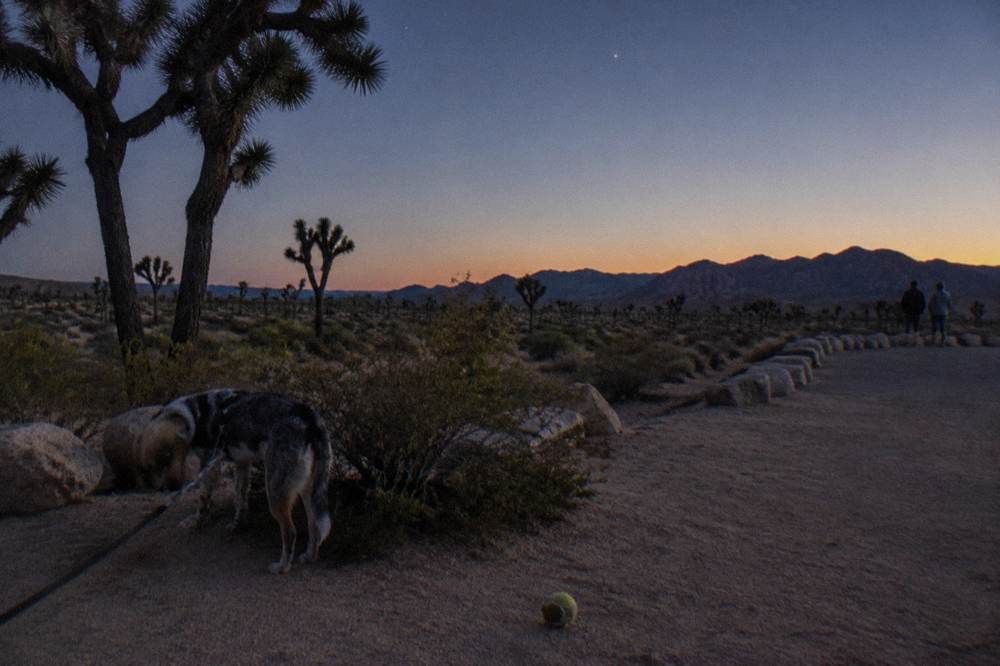
For the sunset-and-stars version of the day, the timing flips. Leave Palm Springs early afternoon, tour the western section as the light drops, and stay for dark at one of the four designated stargazing areas (see Palm Springs Or Joshua Tree). The park asks night visitors to use red lights only, to stay within 20 ft of their vehicle in the designated lots, and to remember that eyes need 20 to 30 minutes to adapt. Bright moonlight reduces the stars you see, so the moon matters more than the clock. The park also prohibits "paint with light" techniques for night photography.
Guided tours handle this arithmetic for you. The sunset stargazing day trip from Los Angeles exists on the roster for exactly this pattern, and the Joshua Tree day trips and private tours category collects the options that build a day around light rather than lunch. From Palm Springs specifically, the Hummer tours' 3-to-5-hour windows can be matched to the best hours of the day with the operator when booking.
What Should You Know Before Leaving Palm Springs?
Before leaving Palm Springs, stock up on everything you need, since the park has no gas stations, restaurants, grocery stores, or hotels, no water in the interior, and only limited cell reception, meaning a dead phone and an empty tank are real risks. Buy your $30 per vehicle entrance pass in advance and print or save it before arrival, as connectivity inside is unreliable, while children under 16 enter free on foot or bicycle.
The visitor centers are the last comfortable stops and worth the ten minutes. The Joshua Tree Visitor Center at 6554 Park Boulevard in the town of Joshua Tree runs 7:30 am to 5 pm daily year-round, with a bookstore and cafe. The park's main visitor center at 6533 Freedom Way in Twentynine Palms runs 8 am to 5 pm, and the Cottonwood Visitor Center on Pinto Basin Road runs 8:30 am to 4 pm. Rangers there give current conditions, and the park publishes its own conditions page for road and weather status before you set out.
A few rules catch visitors by surprise. Pets are not allowed on trails, in the backcountry, or in park buildings, even carried, and must stay within 100 ft of roads and campgrounds on a leash of 6 ft or less, per the park's pets page. Drones are prohibited. Vehicles must stay on designated roads, and ATVs and dirt bikes are not allowed at all. Climbing is permitted, and guides who work in the park must hold a permit, which is a useful check when booking any guided activity.
For tour takers, most of this list disappears. The Backroads Hummer H2 Tour includes the general admission, snacks, bottled water, and an air-conditioned vehicle, leaving gratuities and sunscreen as the notable exclusions. The Offroad 4x4 Park Tour includes water, snacks, and a professional guide but not the entrance fee, and the Paved Road Van Tour from the Palm Desert area lists the $15 per person entrance fee as a separate item. Reading the includes and excludes lines on each listing before booking is the single most useful two minutes of planning.
The final pre-departure question is which entrance. From Palm Springs, the western entrances at the towns of Joshua Tree and Yucca Valley are the natural targets, putting you straight into the Joshua tree forests and the boulder zones. The southern Cottonwood entrance adds distance but delivers the darkest skies and the Cholla Cactus Garden along Pinto Basin Road, which the park itself identifies as one of its least-trafficked, darkest stretches. Our guide to the best time to visit Joshua Tree covers the seasonal trade-offs in depth, and the question of how many days is enough for Joshua Tree decides whether one day from Palm Springs is the whole trip or just the first taste.
The Verdict By Traveller Type
Families with young kids, heat-sensitive travellers, and anyone wanting a slow resort day should think twice, because the park demands water, sun protection, and patience. Everyone else should go: first-timers get the most from a guided tour from the Palm Springs area, independent photographers and hikers from a self-drive with an early start, and budget travellers can split a $30 vehicle pass or take a self-guided audio tour from $16.99 per person.
The type-by-type breakdown from everything above:
| Traveller type | Verdict | Best fit from the listings |
|---|---|---|
| First-time visitor | Go, with a guide | Backroads Hummer H2 Tour, from $159 per person |
| Family or small group wanting privacy | Go | Private Group Adventure, from $275 per person, Palm Springs pickup |
| Open-air experience seeker | Go | Open-Air Hummer Adventure, from $179 per person |
| Budget-conscious group with a car | Go self-drive | $30 per vehicle pass, or the audio tour from $16.99 per person |
| Pool-and-spa traveller | Skip it, or half-day it | A 3-hour morning tour, back by lunch |
The one traveller who should not make the drive is the one who would rather not leave the resort at all, and that is a legitimate preference Palm Springs exists to serve. For everyone else, the honest reporting answer is that the hour of highway is a small price for a park the International Dark-Sky community has recognized, that the park's own published fees make a self-drive day remarkably cheap, and that Joshua Tree Park Tours exists precisely because so many Palm Springs visitors keep arriving at this same question and answering it with a booking.
Common Questions About The Drive From Palm Springs To Joshua Tree
Is Joshua Tree Worth The Drive From Palm Springs?
For most travellers, yes. The park offers boulder fields, Joshua tree forests, and designated dark skies that have no substitute within an hour of Palm Springs, and entry is $30 per vehicle for 7 days. The main exceptions are travellers who would rather not leave the resort, or anyone poorly prepared for heat and sun.
Can You Do A Day Trip To Joshua Tree From Palm Springs?
Yes. The park requires no entry reservation and is open 24 hours a day, and guided tours from the Palm Springs area run 3 to 5 hours. Bring your own food, water, and fuel, since the park has no services inside.
Which Is Better, Palm Springs Or Joshua Tree?
They serve different purposes. Palm Springs is a comfortable base with dining and lodging; the park is the destination with rocks, trees, and night skies but no services at all. Most visitors use Palm Springs as the base and the park as the day's highlight.
How Much Does It Cost To Enter Joshua Tree National Park?
A private vehicle pass is $30 and is valid for 7 days. A per-person pass on foot or bicycle is $15, children under 16 enter free, and the park's annual pass is $55. Guided-tour guests pay a $15 per person entrance fee unless the listing includes admission or they hold their own valid pass.
Do Palm Springs Tours Include The Park Entrance Fee?
Some do and some do not. The Backroads Hummer H2 Tour and the Open-Air Hummer Adventure include general admission; the Offroad 4x4 Park Tour and the Paved Road Van Tour list the entrance fee as a separate item. Check the includes and excludes lines on each listing before booking.