Can I Just Drive Through Joshua Tree National Park?
Yes, you can drive through Joshua Tree National Park with an entrance pass. Here is what a drive-through costs, which roads you can use, and what it misses.
Can I Just Drive Through Joshua Tree National Park?
Yes, you can drive through Joshua Tree National Park, and no reservation is required. You need an entrance pass, which starts at $30 per private vehicle for seven days, and you must stay on designated roads. The park is open 24 hours a day, 365 days a year, but there are no gas stations, restaurants, grocery stores, or water inside, so you arrive with a full tank and your own supplies. If you're basing yourself in Palm Springs and wondering whether the trip makes sense for your budget, our guide to whether Joshua Tree is worth the drive from Palm Springs compares taking a tour against driving yourself.
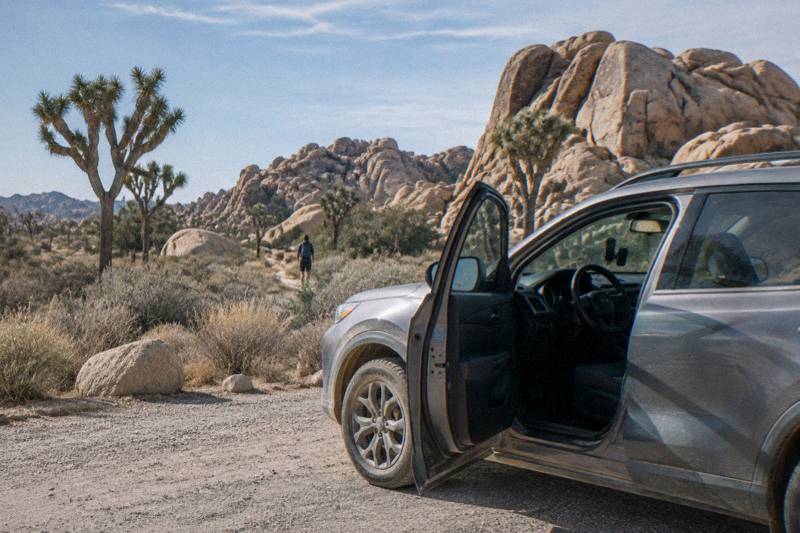
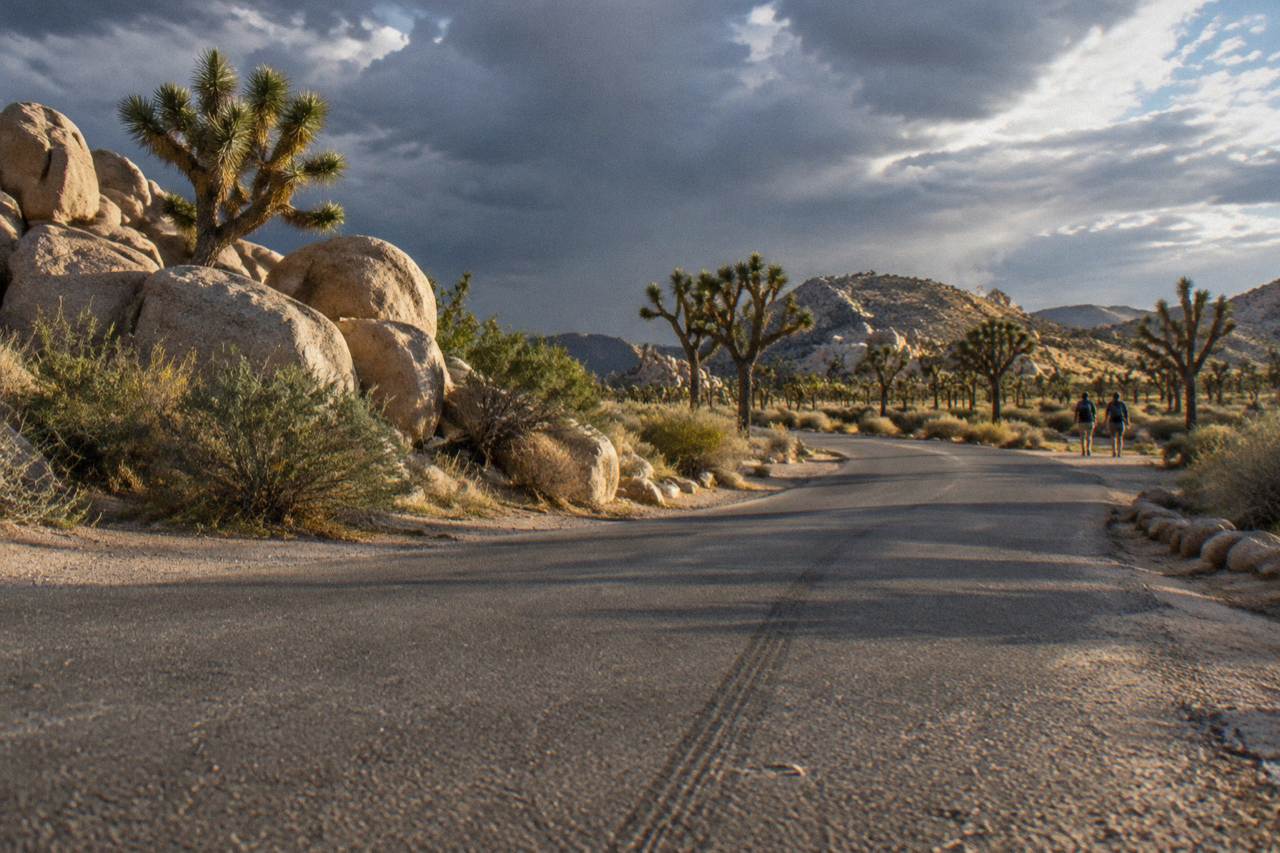
A drive-through is one of the most common ways people experience this park, and for good reason. The two main roads, Park Boulevard and Pinto Basin Road, connect the west and south entrances and pass the heart of the scenery: the boulder piles, the namesake trees, the pullouts at Skull Rock and Keys View. A visitor with three hours and a full tank can see a genuine cross-section of the Mojave and the Colorado Desert from behind a windshield.
What the windshield view cannot do is explain itself. The park publishes its own first-time visitor guidance, which covers hours, rules, and what to expect, and it is worth ten minutes of reading before you go. Beyond that, the choice is between silence and commentary. Some drivers want silence. Others pair the drive with the Self-Driving Audio Tour, from $16.99 per person, which uses GPS to trigger recorded stories as you pass each landmark, and it is rated 4.5 across 806 reviews. A guest review from April puts it plainly: "Fun & easy to do at our own pace. Instructions were easy to follow and download."
This article walks through the cost, the timing, the roads, and the trade-offs, so you can decide whether a pure drive-through is enough or whether a guided layer is worth adding.
How Much Does It Cost To Drive Through Joshua Tree National Park?
Driving through costs $30 per private vehicle for a seven-day permit, which covers everyone in the car. A motorcycle pays $25 for seven days, and a person entering on foot or by bicycle pays $15, with children under 16 free. A Joshua Tree annual pass is $55, and America the Beautiful interagency passes are accepted. Those are the published fees on the park's fees page, and there is no timed-entry fee or reservation charge on top. If you're wondering whether anything beyond that permit needs to be booked ahead, our guide to Joshua Tree entry reservations explains exactly what rangers ask for at the gate.
The pass is the whole cost of a basic drive-through, and it is more flexible than many visitors expect. The seven-day window means you can drive the park on arrival, then come back two days later for a sunset or a stargazing stop without paying again. The park also publishes fee-free days each year for United States citizens and residents: in 2026 those include Presidents Day on February 16, Memorial Day on May 25, Independence Day weekend July 3 to 5, the NPS birthday on August 25, and Veterans Day on November 11.
Where you buy the pass matters less than having it before you arrive. Passes are sold at the Joshua Tree Visitor Center in the town of Joshua Tree, the visitor center in Twentynine Palms, Cottonwood Visitor Center, the North and West Entrance Stations (card only), and online at recreation.gov. Connectivity inside the park is very limited, so a digital pass should be printed or saved to your phone before you reach the booth.
| Pass type | Price | Valid for | Notes |
|---|---|---|---|
| Private vehicle | $30 | 7 days | Covers all passengers of one non-commercial vehicle |
| Motorcycle | $25 | 7 days | Up to 2 motorcycles, 4 total passengers |
| Per person (foot or bicycle) | $15 | 7 days | Age 16 and up; children under 16 free |
| Joshua Tree annual pass | $55 | 12 months | From month of purchase, US citizens and residents |
| America the Beautiful passes | Varies | Per pass terms | Senior, Access, Military and others accepted |
One fee question that catches guided-tour guests specifically: the park publishes a rule that clients of permitted commercial tours pay a $15 per person entrance fee or use their own valid pass. That is separate from your tour price, and the roster listings state it plainly. The Sightseeing Adventure Tour, from $99 per person, notes that a national park pass gets four people in, otherwise it is $15 per person at the entrance. The Paved Road Van Tour, from $249 per person, states the same entrance fee on its listing.
Do You Have To Pay To Drive Into Joshua Tree?
Yes, everyone driving into the park pays the entrance fee or shows a valid pass; there is no free driving route through the park interior. The fee booth is sometimes closed, but that does not make entry free: the park states you may be asked to show a pass or pay on the way out. The only fee-free entries are the published fee-free days for US citizens and residents, and passes like the Senior or Access pass.
The booth-closed detail confuses a lot of first-time visitors, so it deserves its own explanation. The park is open 24 hours a day, and the staffed booth is not. If you enter early in the morning or late at night, you may find an open gate and no ranger. The park's own guidance is unambiguous: you drive in, and you pay or show a pass when asked, including on exit. Honoring that keeps the system working, and rangers do check.
What you get for the fee is worth stating, because it is not just scenery. The pass buys seven days of access to roughly 500 campsites, four visitor centers, ranger programs that need no reservation, and designated stargazing areas at Quail Springs, Hidden Valley, Cap Rock, and Ryan Mountain, all covered in the park's published fee schedule. A drive-through visitor who returns after dark for the night sky has effectively bought two very different park experiences with one pass.
Can I Enter The Joshua Tree At Any Time?
Yes, the park is open 24 hours a day, seven days a week, 365 days a year, and no advance reservation is needed to enter. You can drive in before sunrise or after midnight, and the park explicitly welcomes entry and exit at any time. If the fee booth is closed when you enter, you may be asked to show a pass or pay on the way out. If you're curious what you actually need at the gate, or which parts of a visit do require booking ahead, our guide on whether you need a reservation to enter Joshua Tree National Park has the answers.
That round-the-clock access is unusual among major national parks, and it shapes what a drive-through can be. Night driving is one of the quietest ways to see the park, and the designated stargazing parking lots at Quail Springs, Hidden Valley, Cap Rock, and Ryan Mountain exist precisely for that use. The park asks night visitors to stay awake and within 20 feet of the vehicle, to use red light only, and to give eyes 20 to 30 minutes to adapt. Bright moonlight reduces the stars you see, so the darkest nights are the best ones. Once you've picked a moonless night, the honest comparison of how to get to Joshua Tree helps you sort out entrances, drive logic, and what each option costs.
Daytime timing still matters even though the gate never closes. The park publishes crowding guidance: holidays, weekends from October through May, and spring break from March to mid-April are the busy periods, and entrance lines can stretch. An early morning entry, before the booths get busy, is the classic local move. Summer is a different calculation: typical highs run around 100 F or more, and the park's heat guidance is to avoid midday activity and carry ample water, which a car with air conditioning partly, but only partly, solves.
Can You Just Drive Through The Joshua Tree?
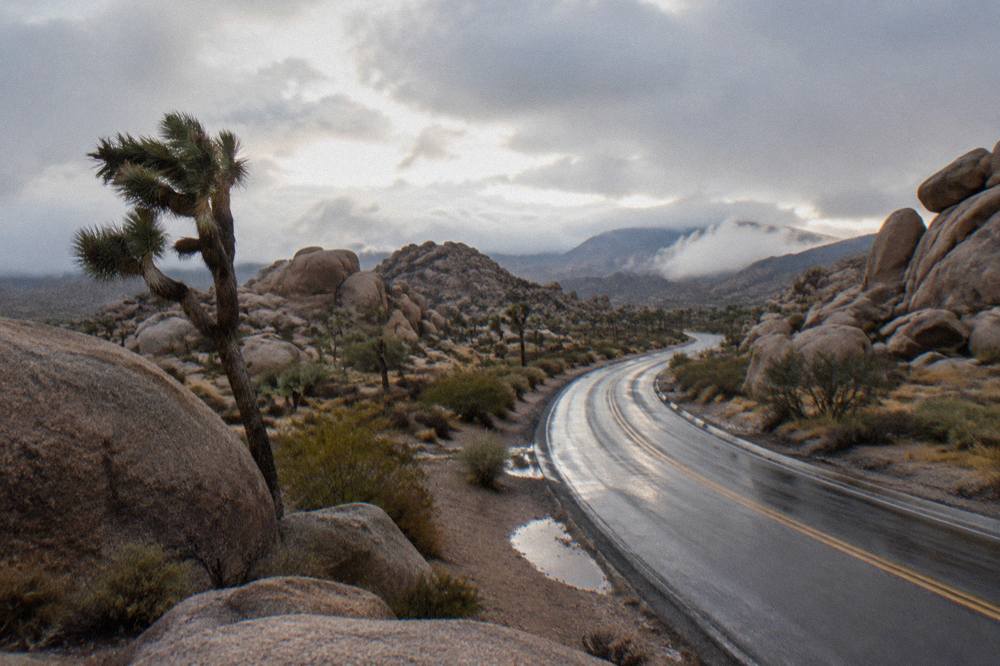
Yes, and most first-time visitors effectively do. The main driving route runs west to south, entering near the town of Joshua Tree and exiting at Cottonwood near Interstate 10, or the reverse. It passes the boulder zones, Skull Rock, and the turnoff to Keys View. The drive itself is the experience for many people, and the park's road network was built for exactly that kind of visit. Before you can cruise that route, you still have to get to the park itself, and the guide to reaching Joshua Tree National Park compares driving yourself, flying in, and arranging a pickup so you can pick what fits your trip.
The phrase "just driving through" undersells what the road delivers, though. This is not a highway with scenery on both sides; it is a slow, winding road that puts you inside the landscape. The transition is dramatic: the Mojave Desert section in the west, with its Joshua trees and monzogranite piles, gives way along Pinto Basin Road to the Colorado Desert, lower, hotter, and dominated by cholla and creosote. The Cholla Cactus Garden pullout sits at that seam and is one of the most photographed spots in the park.
The honest limitation is that a car window flattens scale. The boulders read as backdrop rather than as climbable, hikeable terrain, and the park's best-known features, Hidden Valley, the Joshua tree forests, the overlook at Keys View, reward getting out even briefly. A drive-through with four or five short stops takes a few hours and delivers far more than a nonstop transit. The park's own framing supports this: it publishes pullouts, parking, and picnic areas precisely so drivers break up the run.
Can You Drive Your Car Through The Joshua Tree?
Yes, any street-legal car can drive the park's main paved roads; you do not need four-wheel drive. Park Boulevard, Pinto Basin Road, and Keys View Road are paved and passable in an ordinary sedan. The rule is that vehicles must stay on designated roads, and off-highway vehicles, ATVs, UTVs, and dirt bikes are prohibited inside the park entirely.
The vehicle rules are strict and worth knowing before you arrive. Street-legal motorbikes and bicycles share the same designated-road rule. Drones are prohibited from launching, landing, or operating in the park. Pets must stay within 100 feet of roads, parking areas, and campgrounds, must be leashed at six feet or less, and are not allowed on trails or in the backcountry, even carried. If your plan was a drive-through with a dog, that plan works, as long as the dog stays near the car at the pullouts.
Unpaved roads do exist in the park, and some are rough enough that the park warns against them for regular vehicles. Check the park's current conditions before committing to any dirt road, because status changes with weather. For most drive-through visitors the paved loop is the whole itinerary, and it does not need anything more capable than a compact car.
What Does A Drive-Through Miss Compared To A Guided Or Audio Tour?
A drive-through misses interpretation, trail access, and heat-smart timing. The roads show you the park's scenery but not its names, stories, or hidden corners, and guides choose routes and stops you would not find on your own. Audio tours close part of that gap cheaply, while guided van and hiking tours close more of it, at prices from $16.99 per person for audio to $409 per person for a full-day guided hike.
The cheapest fix is audio. The Self-Driving Audio Tour, from $16.99 per person, is a GPS-triggered app commentary that runs for 3 to 4 hours of driving, works offline, and includes route maps and suggested stops; it is rated 4.5 across 806 reviews. A variant aimed at Los Angeles visitors, the Audio Driving Tour from Los Angeles, runs from $19.99 per person over a 15 to 16 hour round trip and is rated 4.7 across 26 reviews (see LA Day Trip). There is also a budget option, the Audio Tour and Local Guide, from $15 per group, rated 4.2 across 90 reviews. Each of these keeps you in your own car, at your own pace, with a voice filling the silence.
The fuller fix is a human. The Paved Road Van Tour, from $249 per person for five hours, covers the same road network with a professional guide, live commentary, water, and snacks, and is rated 4.9 across 302 reviews. Maria, a guest on that tour, described her guide as "full of personal knowledge of the Palm Desert area and of our destination." The Sightseeing Adventure Tour, from $99 per person for 4 to 5 hours, sits between the two: private transportation with a guide, rated 4.9 across 178 reviews. And if you want to leave the car entirely, the Half-Day Guided Hike, from $335 per person and rated 5.0 across 122 reviews, takes you onto trails a windshield never touches.
Which Route Should A First-Time Driver Take Through The Park?
The classic first drive enters at the West Entrance near the town of Joshua Tree, follows Park Boulevard east through the boulder zones and Skull Rock, turns south on Pinto Basin Road past the Cholla Cactus Garden, and exits at Cottonwood toward Interstate 10. Driven straight through it takes a few hours; with stops at Hidden Valley, Cap Rock, and Keys View it fills half a day. If you're staying over in Palm Springs, our guide to whether Joshua Tree is worth the drive from Palm Springs weighs joining a tour against making the trip in your own car.
Direction matters less than pacing, but the west-to-south direction has one real advantage: the scenery builds. You start in the dense Joshua tree stands and stacked granite of the Mojave section, where the park's signature look lives, and finish in the open Colorado Desert basin. Reversing the route saves nothing and gives you the finale first.
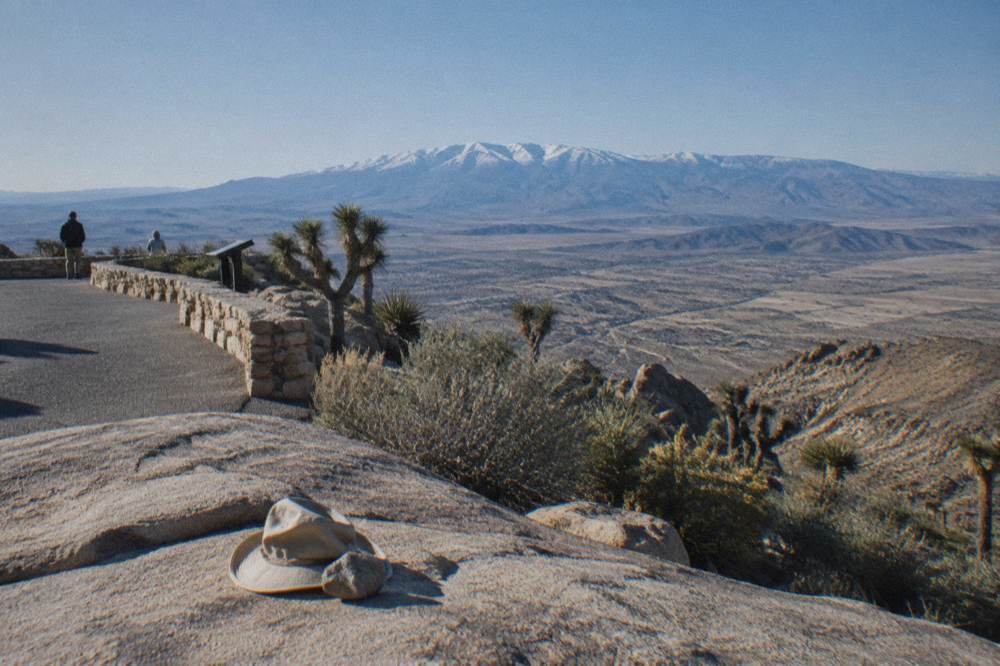
Build in the detour to Keys View even though it adds distance from the main road. The overlook sits high on the Little San Bernardino Mountains and looks out over the Coachella Valley. On clear days it is one of the widest views reachable by car in the park. Skip it only if you are short on daylight, and remember that the park has no gas, no water, and no food anywhere inside, so the turnoff is a decision about your supplies as much as your time.
Is Driving Yourself Better Than Taking A Tour Of Joshua Tree?
Driving yourself wins on cost, flexibility, and solitude: $30 per vehicle, your own schedule, and the freedom to stop for an hour at a quiet pullout. A tour wins on knowledge, safety in heat, and access to interpretation you cannot improvise. The two are not exclusive either, since an audio tour from $16.99 per person converts a self-drive into something close to a guided one.
The self-drive case is strong and this site covers it in detail elsewhere; the comparison of guided tours versus driving yourself is laid out in guided tours versus driving yourself. The short version: if you read ahead, start early, and treat the park's pullouts as your itinerary, a self-drive delivers most of the headline experience. The one day in the park itinerary is built around exactly that assumption.
The tour case rests on things a car cannot supply. A guide reads the light, the season, and the crowd, and adjusts. Guided hikes reach places roads do not. The offroad 4x4 tour, from $249 per person and rated 4.9 across 471 reviews, takes vehicles onto terrain your sedan cannot legally or physically go. And for visitors who want a middle path, Joshua Tree Park Tours maintains a full roster across Joshua Tree self-guided audio tours, guided hikes, van tours, and climbing, so the decision is really about how much structure you want on the day.
Common Questions About Driving Through Joshua Tree National Park
Can I Just Drive Through Joshua Tree National Park?
Yes, with an entrance pass. The park is open 24 hours a day, year-round, and no reservation is needed. Stay on designated roads, and arrive with fuel, water, and food, because the park has no gas stations, restaurants, or water inside.
How Much Does It Cost To Drive Through Joshua Tree National Park?
A private vehicle pays $30 for a seven-day pass covering all passengers. Motorcycles pay $25, and walkers or cyclists pay $15 per person, with children under 16 free. An annual park pass is $55.
Do You Have To Pay To Drive Into Joshua Tree?
Yes. There is no free driving route through the park interior. If the fee booth is closed when you enter, the park states you may be asked to show a pass or pay on exit.
Can I Enter The Joshua Tree At Any Time?
Yes. The park is open 24 hours a day, seven days a week, 365 days a year, and visitors may drive in and out at any time. Night entry is popular for stargazing at the designated areas.
Can You Drive Your Car Through The Joshua Tree?
Yes, any street-legal car handles the main paved roads. Vehicles must stay on designated roads, and ATVs, UTVs, and dirt bikes are prohibited in the park. Some unpaved roads require high clearance; check current conditions before attempting them.
Do You Need A Reservation To Enter Joshua Tree National Park?
No. The park publishes that reservations are not required for entrance and there is no timed-entry system. Campgrounds and Keys Ranch ranger tours are the exceptions, both booked separately.