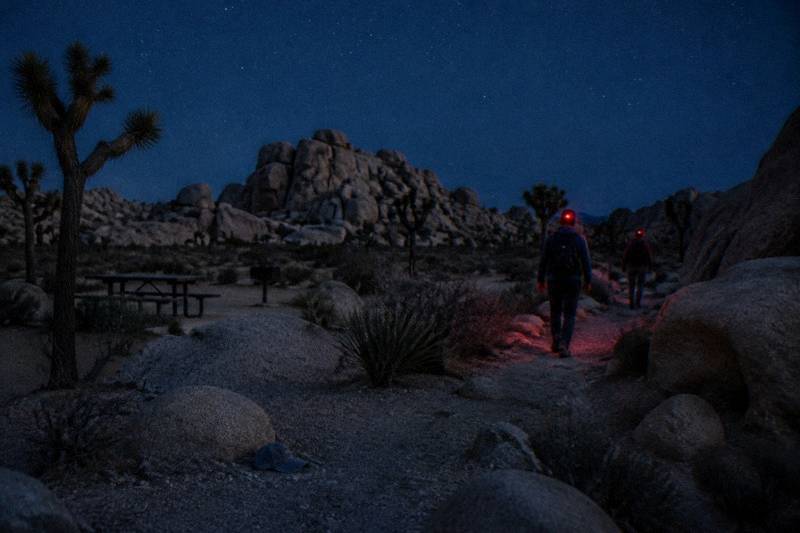
Is It Safe To Be In Joshua Tree At Night?
An honest answer to night safety in Joshua Tree National Park: the 20 ft vehicle rule, red-light etiquette, no cell service, cold nights, and when a guided stargazing session makes sense.
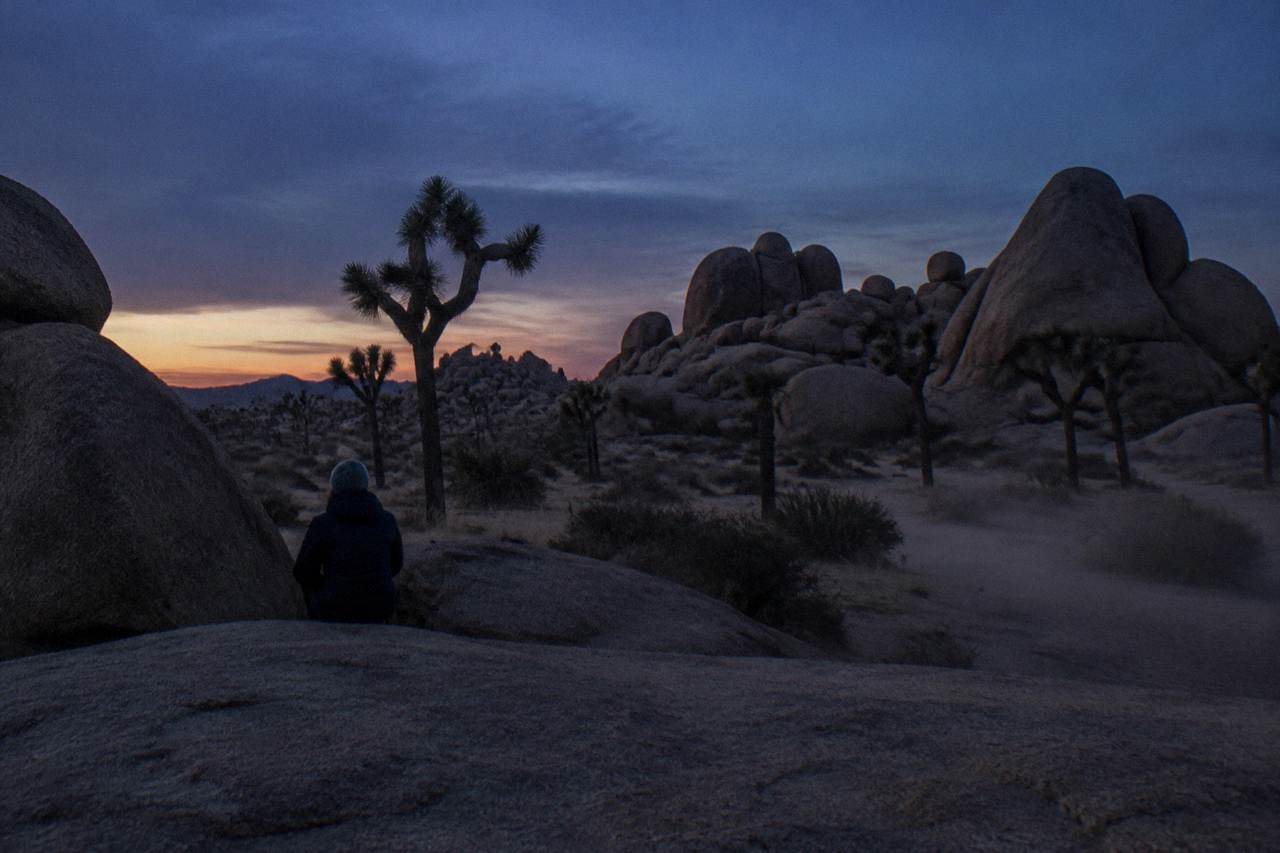
Night in Joshua Tree National Park is the reason many people come in the first place. The park is open 24 hours a day, every day of the year, and it holds an International Dark Sky Park designation, Silver Tier, from DarkSky International since 2017. Darkness that deep is rare in southern California. It also removes the things most day visitors lean on without thinking: daylight, cell signal, water faucets, and other people. The honest answer to whether a night visit is safe sits somewhere between those two facts. If those dark skies are the whole reason you're headed to the desert after sundown, our comparison of Anza-Borrego and Joshua Tree for stargazing can help you figure out which park deserves your night.
Is It Safe To Be In Joshua Tree At Night?
Yes, for most visitors, provided you follow the park's own night rules: stay within 20 ft (6 m) of your vehicle at the designated stargazing areas, use red light only, and go in prepared for cold, no water, and no cell reception anywhere in the park interior. The park publishes these rules because they work. The hazards here are darkness, distance, and exposure, not crime, and a little planning removes almost all of the risk. Once you know how to stay safe after dark, the next question is which desert park earns your night out, and this Joshua Tree versus Death Valley stargazing comparison covers the designated night-sky areas, tour options, fees, and timing to help you decide.
The park's stargazing guidance is unusually specific for a national park, and it is worth reading as a safety document rather than a suggestion. At the four designated stargazing areas, visitors are asked to stay awake and within 20 ft of their vehicle. That single rule solves most night problems at once: you cannot get lost 20 ft from your car, you have shelter if the cold bites, and you have a way out if something goes wrong. If you're weighing whether Joshua Tree or Death Valley offers the better night sky, our Joshua Tree versus Death Valley stargazing comparison covers the viewing spots, tour options, and timing side by side.
The rest of the guidance is about light discipline. Eyes need 20 to 30 minutes to adapt to darkness, and one careless white headlamp or phone screen resets that clock for everyone nearby. Red lights only. Layer up, bring a chair and water. None of this is difficult, but every item on that list exists because someone learned it the hard way.
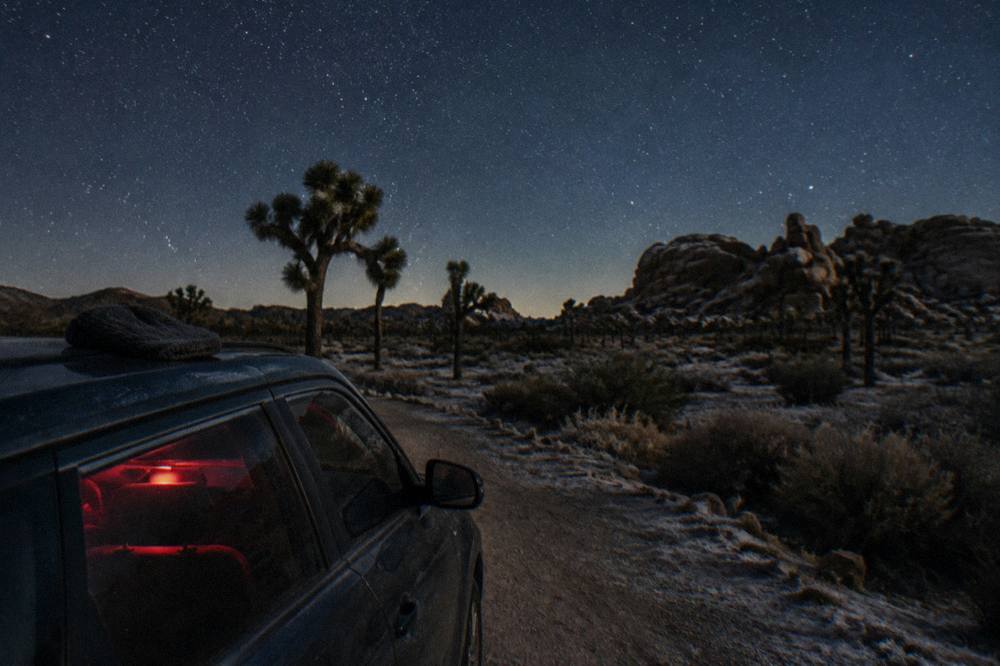
For visitors who would rather not manage any of this alone, a guided night outing moves the whole checklist onto someone else. This site's Joshua Tree Park Tours roster includes a Starlight Hike from $95 per person, a two-hour guided walk that includes access to a trailhead inside the park, plus two stargazing sessions that run on private land just outside the park in Yucca Valley. Guides carry the route knowledge, the lighting discipline, and the judgement about when to turn back.
The guided option deserves a plain-worded caveat that too many booking pages skip: the two stargazing sessions in that list, the Professional Stargazing Night from $200 per person and the Stargazing Experience from $189 per person, both run on private land in Yucca Valley, outside the national park boundary. No park entry and no park pass is involved. The Starlight Hike is the one that goes into the park itself. Knowing which land you are standing on matters when you are deciding what to pack, what the weather exposure is, and how far help would have to travel. Land access, crowd levels, and stargazing quality all shift depending on which desert you pick, so a side-by-side look at Anza-Borrego versus Joshua Tree can help you weigh the two before you book anything.
What Are The Real Night Hazards In Joshua Tree National Park?
The hazards are environmental and logistical, not social. The park has no gas stations, no restaurants, no water in the interior, and very limited cell reception, so a minor problem at night, an empty tank, a twisted ankle, a dead battery, becomes a serious one fast. Cold is the most underestimated risk: desert nights drop sharply, and winter nights can fall to near or below freezing even after a mild day.
The park says it directly on its first-time-visitor page: there is no water in the park interior and cell reception is very limited. During the day that is an inconvenience. At night it changes your math. If something breaks, you cannot call a tow from Cap Rock at midnight, and nobody is coming past on the regular. Roadside assistance can take a long time to reach the park's interior roads.
Cold is the one that catches southern California visitors. Spring and fall nights sit around 50 F (10 C) after days of 70 to 85 F, and winter nights reach near or below freezing, with occasional snow at higher elevations. People who step out of a warm car in a T-shirt for "a quick look at the stars" routinely end the night shivering. The park's own stargazing advice leads with layering, a chair, and water, in that order of practicality.
| Night hazard | Why it matters after dark | What the park advises |
|---|---|---|
| No cell reception | Very limited service in the park; emergency calls may not connect | Plan self-sufficiency; tell someone your plans |
| No water in the interior | No faucets, no stores, nothing to drink | Carry all the water you need |
| Cold nights | Lows near 50 F in spring and fall, near or below freezing in winter | Layer up; bring a chair and water |
| Darkness and disorientation | Terrain and roads look unfamiliar at night | Stay within 20 ft of your vehicle at designated areas |
| Wildlife | Present but not a leading cause of incidents; encounters are rare and unquantified | Keep distance; never feed or approach animals |
One entry in that table needs honest framing rather than reassurance. Wildlife encounters at night are the fear most first-time visitors name, and the park does not publish statistics on snake or animal incidents, so any specific number you read elsewhere is invented. What the park does publish is behavioural guidance: give animals distance, never feed them, and store food properly if you are camping. In practice, the animals you are most likely to see at night are the small and uninterested kind, and the things most likely to hurt you are the ground you cannot see and the temperature you did not dress for.
If reading this list makes your shoulders tighten, that is a reasonable signal to buy supervision rather than skip the night entirely. The park's stargazing page covers the rules for independent visitors; a guided session covers the rest.
Can You Enter Joshua Tree At Night For Free?
No, the park entrance is not free at night, but entry after booth hours works on trust: the park is open 24 hours a day, 365 days a year, and if the fee booth is closed you may drive in and pay or show your pass on the way out. A private vehicle pass costs $30 for 7 days, a motorcycle pass $25, and entry on foot or bicycle is $15 per person.
That "pay on the way out" arrangement surprises people, so it is worth stating plainly: there is no gate, no barrier arm, and no timed-entry reservation system at Joshua Tree. The park's first-time-visitor page confirms that reservations are not required for entrance, and that visitors are welcome to drive in and out at any time. Night entry is not a loophole; it is a designed feature of a park that wants people to see its skies. That openness after dark makes more sense once you know the story behind the park itself, and our guide to the Joshua tree's strange beauty and famous night skies explains why so many travelers plan an entire trip around it.
What is genuinely free is the sky itself once you have paid entry or hold a pass, and the park's fee-free days in 2026 waive the entrance fee entirely on the park's published list for US citizens and residents. Children under 16 need no pass on foot or bicycle. Ranger programs, including night sky and astronomy programs that run through the year, are free and need no reservation; schedules are posted on park bulletin boards, the calendar, and at visitor centers.
The distinction between "free to enter" and "free once inside" matters enough that we give it a page of its own. For the full breakdown of passes, the annual $55 park pass, and what the guided-tour guest fee situation is, read the Joshua Tree entrance fee and passes guide; the short version for night visitors is that your 7-day vehicle pass covers every stargazing session on that trip.
Is It A Good Time To Go To Joshua Tree Now?
The best honest answer is seasonal, not current: October through May is when the park's own guidance points night visitors, with comfortable evening temperatures and the full campground network running. Summer nights stay warm, near 75 F, but summer days bring extreme heat and the park imposes seasonal restrictions, including an annual campfire ban from June 15 to October 1.
We deliberately do not tell you whether a road or trail is open on the day you read this, because that status changes and any page that states it flatly is wrong a week later. The park publishes live conditions and alerts on its own pages, and the reliable habit is to check the park's conditions page the morning of your night outing. Wind, blowing dust, and flash-flood risk in low-lying washes are real desert phenomena that the park's safety guidance asks visitors to monitor.
The seasonal rhythm is stable enough to plan around, though. Fall and spring deliver the combination night visitors want: daytime highs of 70 to 85 F cooling to around 50 F after sunset, which is jacket weather rather than survival weather. Winter offers the longest nights and the clearest air, at the price of genuine cold. Summer flips the calculus; a stargazing session that starts at 9 pm in July is honestly pleasant, but you will have driven in through extreme heat to get there, and the park's summer restrictions page governs what is allowed.
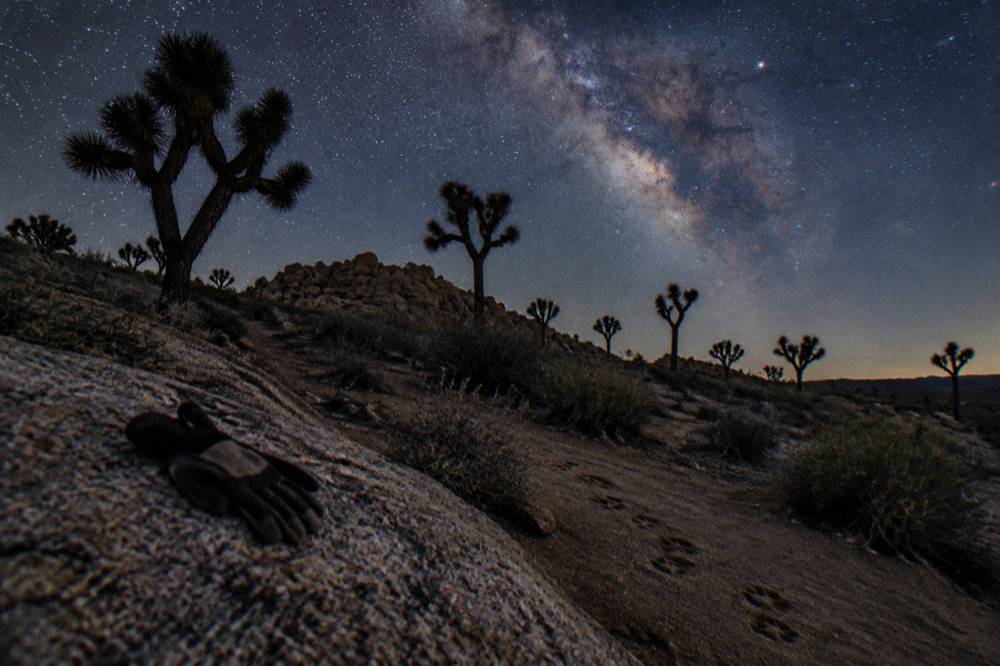
Moon phase is the other piece of timing that people forget until they are standing under a washed-out sky. Bright moonlight reduces the stars you can see, so the park's stargazing advice is to avoid the moon. The Milky Way's galactic center is at its best on moonless summer nights. If your trip dates are flexible, plan around the new moon; if they are not, a bright moon is still a beautiful thing to walk under, and the Starlight Hike, a two-hour guided walk from $95 per person, runs regardless of lunar phase because its focus is the landscape rather than deep-sky detail.
Where Are The Designated Stargazing Areas And Why Do They Matter For Safety?
The park names four designated stargazing areas, all parking lots: Quail Springs, Hidden Valley, Cap Rock, and Ryan Mountain. At these lots the rule is to stay awake and within 20 ft (6 m) of your vehicle. The designation concentrates night visitors on real pavement with known access roads, which is exactly what you want when something goes wrong at midnight.
These four lots were chosen for darkness and for practicality. They sit on the park's main paved roads, Park Boulevard and the connected routes, so the drive in and out is on solid surface rather than washboard dirt. Concentrating night visitors also means you are rarely alone in the dark; the quietest designated lot on a clear weekend still has a few other cars in it, and on a moonless summer night they fill up.
For visitors chasing the darkest possible sky, the park adds two pointers: Cottonwood Campground has the darkest skies among the campgrounds, and the pullouts along Pinto Basin Road between the Cholla Cactus Garden and Cottonwood see the least traffic and the least light. Those roadside pullouts trade some convenience for darkness. If you use one, the 20 ft rule's logic still applies even where the letter of it addresses the designated lots: stay near the car, stay off the road shoulder, and be visible to the occasional passing truck.
The photography rule surprises people who have seen long-exposure light-painting shots taken elsewhere. The park does not permit paint-with-light techniques at night, which protects everyone else's dark adaptation. A red headlamp and patience get you the same photos in most cases, and the Joshua Tree stargazing guide covers the practical side of cameras, apps, and planning around the moon in more depth.
Should You Take A Guided Night Tour Instead Of Going Alone?
Yes, for most visitors a guided night tour is the smarter choice: guides handle route-finding in the dark, carry proper lighting, know the terrain, and make the go or no-go call when weather turns. Going alone raises the stakes for little savings. Guided options here include the in-park Starlight Hike from $95 per person, plus two Yucca Valley sessions on private land outside the park.
The honest comparison is about what you give up and what you get. Going alone costs you the $30 vehicle pass and gives total freedom: your own car, your own schedule, your own silence. A guided session costs from $95 to $200 per person and gives you someone who has walked that ground in the dark many times, who brought the telescope or the route plan, and who is legally operating under a park permit for guided activities, a point the park's commercial-use page is explicit about when it tells visitors to check their guide holds one.
The Professional Stargazing Night illustrates what a specialist session adds. From $200 per person for two hours, it includes telescopes, astro-binoculars, an astronomer, blankets, a Yogibo lounger, and coffee or tea, and it is rated 4.9 across 179 reviews. It runs on private land just outside the park in Yucca Valley, so no park pass is needed and no park entry happens; that is stated plainly on the listing and repeated here because it changes what you pack and what the experience covers. Transportation is not included, and there is no restroom on site.
The Stargazing Experience, from $189 per person for two hours, also runs on private land in Yucca Valley outside the park boundary. Its review pool is small, 11 reviews, too few for a star claim in either direction. What it offers is the same private-land dark sky with a guide who sets the pace, and the same no-park-pass logistics.
For visitors who specifically want to be inside the park at night, on foot, under the rules covered above, the Starlight Hike is the fit. Two hours from $95 per person, meeting in the Joshua Tree area, with access to a trailhead inside the park included and private transportation not included. It has no review count on the listing to print, which we state plainly rather than dress up. A guided walk after dark is also the format where the park's 20 ft rule gently gives way to something better: a guide who keeps the group together on a known route.
Families weighing the decision can read the broader case for organized nights on the Joshua Tree stargazing tours hub, and the wider question of daytime risks is covered in what to be careful of in Joshua Tree, which covers the heat and terrain hazards that the daytime version of this question turns on.
How Do You Stay Safe Driving In Joshua Tree After Dark?
Drive slower than the posted limit suggests, watch for wildlife on the road surface, and treat every dirt-road decision as final: the park prohibits ATVs, UTVs, OHVs and dirt bikes, and street-legal vehicles must stay on designated roads. Fuel up before entering, because there are no gas stations inside the park, and a wrong turn at night costs more time than the same mistake by day.
The park's roads are the most under-discussed night hazard. Park Boulevard and Pinto Basin Road are paved and generally in decent condition, but they are unlit, they curve through rock, and they carry the occasional deer or kit fox standing in the roadway exactly where your headlights are weakest. The instinct to rush to a stargazing lot before the sky fully darkens is how speed meets a blind curve. The sky will be there in fifteen minutes.
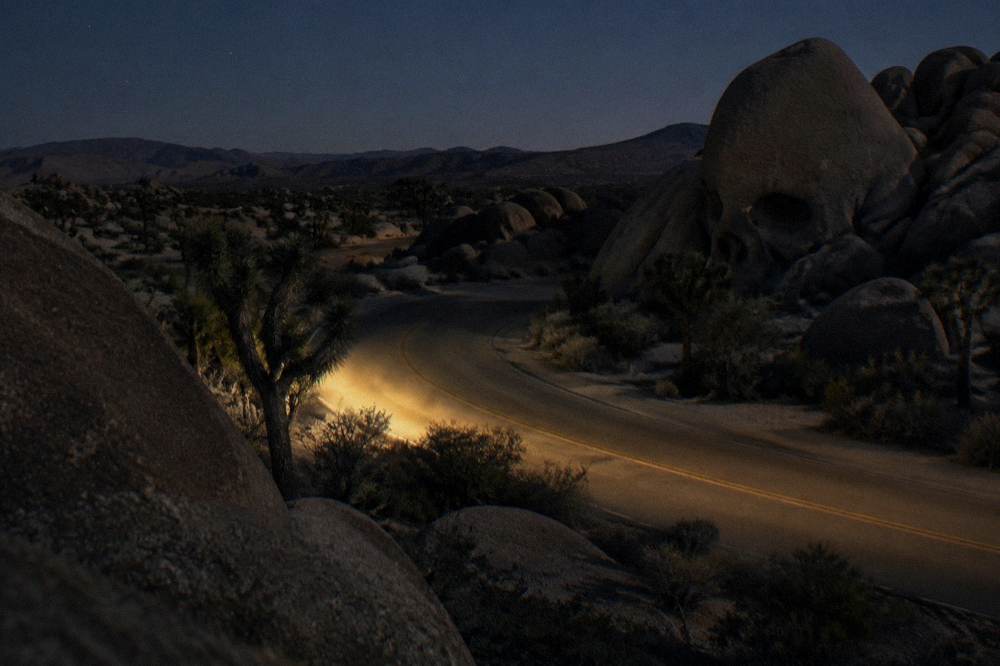
Dirt roads are a separate decision. The park allows street-legal vehicles on designated roads only, and a washboard route that is easy in daylight becomes a navigation test at night, with turnouts that look identical and signage that catches light poorly. If your night plan involves a dirt road and you have not driven it in daylight, the conservative call is to change the plan or drive it in daylight first. The park's rules are collected on its first-time-visitor page, which is the page its night-safety guidance hangs off.
Practical habits that hold up: arrive with a full tank, keep a physical map because GPS routing in the park is unreliable, let someone outside the park know your plan and your expected return, and keep your red headlamp in the cupholder rather than the trunk. The last one sounds trivial until you are standing in a pitch-dark parking lot hunting through gear while your eyes burn from the dome light.
What Should You Pack For A Night Visit To Joshua Tree?
Pack for cold, darkness, and self-sufficiency: warm layers beyond what the evening feels like it needs, a red-light headlamp per person, more water than you expect to drink, snacks, a physical map, a fully charged phone used sparingly, and a chair if you are staying at a stargazing lot. There is nowhere inside the park to buy, fill, or charge anything.
The layering advice bears repeating because it is the most violated rule of desert nights. The temperature swing between sunset and two hours later is real in every season, and the park's climate figures put typical spring and fall lows around 50 F with winter nights at or below freezing. A down jacket in October is not paranoia; it is the difference between an hour at Cap Rock and twenty minutes of it.
| Item | Why it matters at night | Park source or rule |
|---|---|---|
| Warm layers | Lows near 50 F in spring and fall, near or below freezing in winter | Park stargazing and conditions guidance |
| Red-light headlamp | White light resets 20 to 30 minutes of dark adaptation, yours and everyone else's | Stargazing rules, red light only |
| Water | No water available in the park interior | First-time-visitor page |
| Physical map | Very limited cell reception; GPS unreliable | First-time-visitor page |
| Chair or mat | Stargazing means standing or sitting still, which accelerates cold | Stargazing guidance |
| Full tank before entry | No gas stations inside the park | First-time-visitor page |
Photographers should add the park's own constraint to their kit planning: paint-with-light is not permitted for night photography, so leave the bright auxiliary lights at home and work with what the sky gives. Everyone else should leave the phone in a pocket except for emergencies and maybe one moonlit photo; the screen is a white light, and every glance costs your eyes their adaptation and the people next to you theirs.
Common Questions About Night Safety In Joshua Tree
Is It Safe To Be In Joshua Tree At Night?
Yes, for most visitors who follow the park's night rules: stay within 20 ft of your vehicle at the designated stargazing areas, use red light only, and prepare for cold, no water, and very limited cell reception. The main hazards are environmental, not social, and preparation removes most of the risk.
Can You Enter Joshua Tree At Night For Free?
No, entry is not free, but the park is open 24 hours a day, 365 days a year, and if the fee booth is closed you may pay or show your pass on the way out. A private vehicle pass is $30 for 7 days; entry on foot or bicycle is $15 per person, and children under 16 enter free on foot or bicycle.
Is It A Good Time To Go To Joshua Tree Now?
October through May is the season the park's own guidance favours for night visits, with evening temperatures around 50 F and full campground operations. For current road, trail and weather status, check the park's own conditions and alerts pages on the day of your visit, because that status changes and is not printed here.
Where Are The Designated Stargazing Areas In The Park?
The park names four designated stargazing areas, all parking lots: Quail Springs, Hidden Valley, Cap Rock, and Ryan Mountain. Visitors are asked to stay awake and within 20 ft (6 m) of their vehicle at those lots.
Do The Stargazing Tours Go Inside The National Park?
Two of them do not. The Professional Stargazing Night and the Stargazing Experience both run on private land just outside the park in Yucca Valley, with no park entry and no park pass involved. The Starlight Hike is the guided option that includes access to a trailhead inside the park.
What Light Should I Use At Night In Joshua Tree?
Red light only. Full dark adaptation takes 20 to 30 minutes, and any white headlamp, flashlight, or phone screen resets it for you and for everyone around you. Bright moonlight also reduces the stars you can see, so plan around the new moon for the darkest skies.