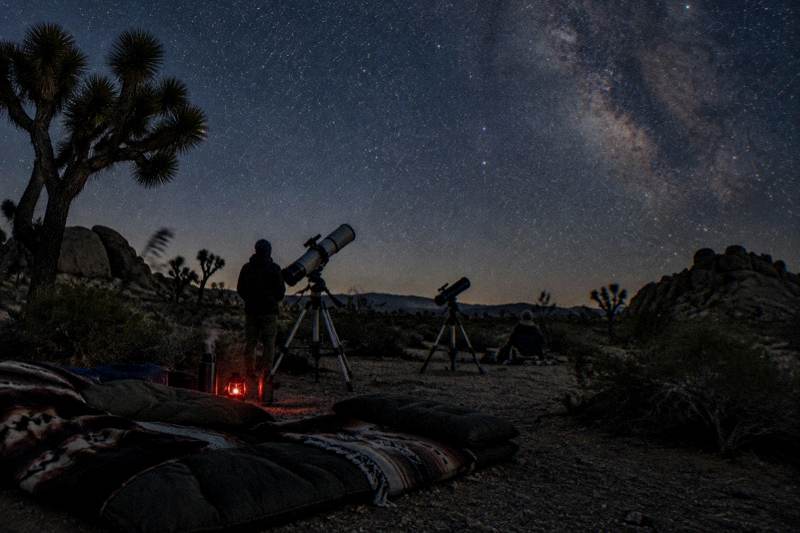
Milky Way Season In Joshua Tree: When The Galactic Core Shows
The galactic core, the brightest, densest section of the Milky Way, does not hang over Joshua Tree National Park all year. It follows a seasonal pattern, and the moon can erase it entirely on the wrong night. Here is how the season works, what the park's own rules say, and which guided nights take the planning off your plate.
Short answer
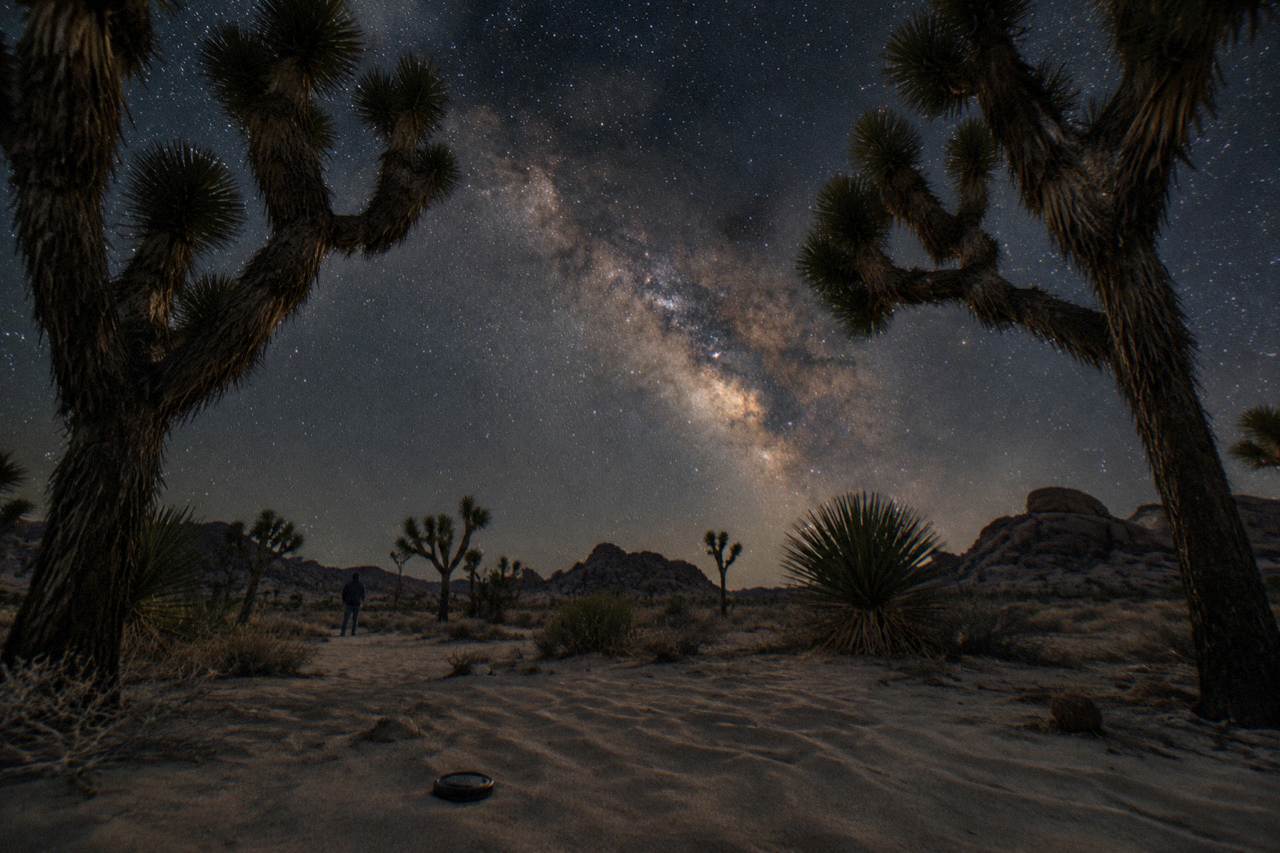
The Milky Way's galactic core is at its best on moonless summer nights in Joshua Tree National Park, an International Dark Sky Park. Plan around the moon rather than the calendar: dark, moonless nights, clear desert air, and the park's four designated stargazing areas give you the core. A guided night tour removes the timing and route guesswork.
The Milky Way over Joshua Tree National Park is not a lucky accident. The park sits far from the light domes of the Coachella Valley cities, holds an International Dark Sky Park designation from DarkSky International, and publishes its own set of designated stargazing areas for exactly this purpose. What trips most visitors up is not darkness, it is timing. The galactic core, the bright central section of the Milky Way that photographers chase, keeps a seasonal schedule, and the moon keeps a monthly one that can wash out even a perfectly clear desert night.
This guide lays out the seasonal pattern as the park's own stargazing pages describe it, the moon-avoidance rule in plain terms, the night-sky rules that apply to everyone in the park after dark, and the guided options, from the Stargazing Experience to the Professional Stargazing Night, that remove the guesswork. For specifics on any given night, the park's guidance is simple: check a moon-phase and Milky Way app, since no printed calendar stays accurate for long.
When Is Milky Way Season In Joshua Tree?
The Milky Way's galactic core is at its best on moonless summer nights, per the park's own stargazing guidance. That is the durable pattern: the core rises favorably in the warmer months and fades from easy view in the cold ones, while the rest of the Milky Way remains faintly visible year-round on dark nights. Season sets the ceiling, the moon sets the floor.
The park's stargazing page puts it plainly: the Milky Way, including the galactic center in Sagittarius, is at its best on moonless summer nights. That is the whole seasonal rule in one sentence, and everything else in planning flows from it. Summer in the desert means overnight lows near 75 F rather than frost, which makes a 2 a.m. session survivable, though daytime heat above 100 F makes the hours before midnight the wrong time to be hiking to a viewpoint.
The seasonal shape matters because the galactic core is only above the horizon during dark hours for part of the year. In the core months, it climbs high enough over the southern horizon to clear the ridgelines and Joshua tree silhouettes that make the park's night photos so recognizable. Outside those months, the core is either below the horizon during darkness or only briefly grazing it, and what you see instead is the dimmer outer band of the galaxy, still visible from a dark site but without the dense star clouds people picture when they say "Milky Way."
Weather is the third variable. Spring and fall bring average highs around 85 F and lows near 50 F, comfortable nights with a chance of wind. Winter nights sit near or below freezing at higher elevations, occasionally with snow. Summer carries monsoon moisture and flash-flood risk from summer storms, so the park's safety guidance says to monitor weather and avoid low-lying areas and washes. None of this changes the season, it just changes what you wear and where you stand.
Where Are The Designated Stargazing Areas In The Park?
The park names four designated stargazing areas, all parking lots: Quail Springs, Hidden Valley, Cap Rock and Ryan Mountain. Visitors are asked to stay awake and within 20 ft of their vehicle, use red lights only, and bring layers, a chair and water. For darker skies, the park points to Cottonwood Campground and the Pinto Basin Road pullouts.
Those four lots sit along the main roads in the park's busier northern half, which makes them the practical default for most visitors: you drive to pavement, step out, and look up. The park's stargazing page frames them as the designated places to settle in for the night, with the 20 ft rule existing so that drivers can see people near the lots and so that visitors do not wander into terrain in the dark. Ryan Mountain's lot doubles as a trailhead, but the designated area is the parking itself, not the trail after dark unless you are on a permitted night hike.
The darker alternatives are real. The park's own page singles out Cottonwood Campground, in the park's southeastern corner, as the darkest of the campgrounds, and describes Pinto Basin Road between the Cholla Cactus Garden and Cottonwood as having the least traffic and the darkest skies. If you are chasing the galactic core rather than a Joshua tree silhouette in the foreground, the southeast corner trades the iconic foreground for measurably less skyglow.
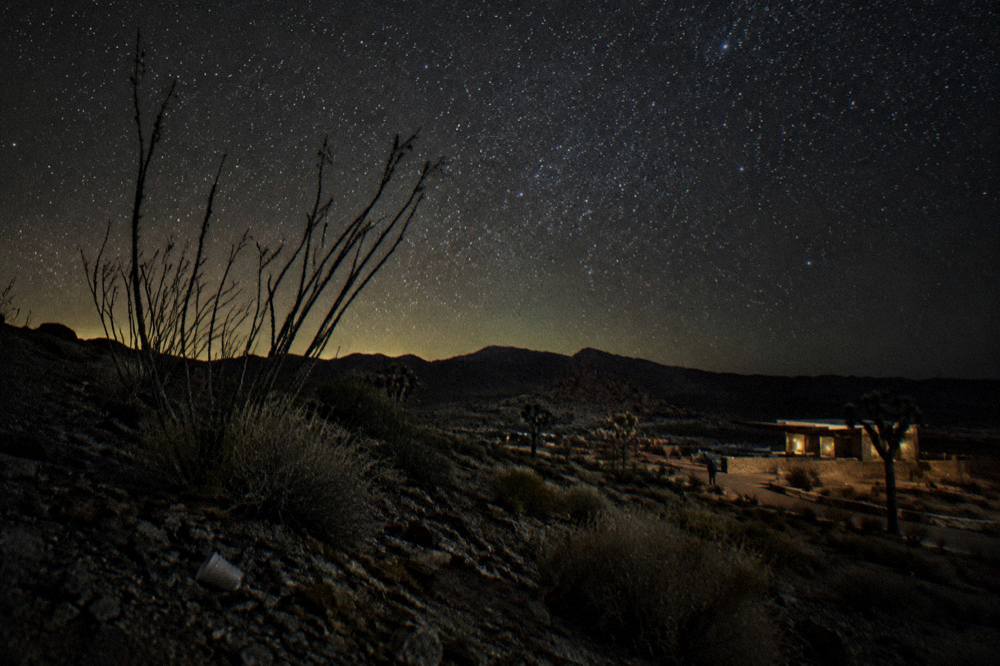
One planning note that surprises people: the park has no gas stations, restaurants or water in the interior, and cell reception is very limited. Whatever you need for a night session, you carry it in. The park is open 24 hours a day, year-round, and you may drive in and out at any time, so a late exit is fine, but the fee booth is sometimes closed and you may be asked to show a pass or pay on the way out.
| Designated area | What it is | Why choose it |
|---|---|---|
| Quail Springs | Parking lot, main road network | Easy access, central location |
| Hidden Valley | Parking lot near popular rock formations | Rock silhouettes for foregrounds |
| Cap Rock | Parking lot, split-rock formation | Iconic foreground, short walk options |
| Ryan Mountain | Trailhead parking lot | High surrounding terrain, dark horizon to the south |
| Cottonwood Campground (darker) | Campground, park's southeast corner | Darkest skies of any campground, per the park |
| Pinto Basin Road pullouts (darkest) | Roadside pullouts, Cholla Cactus Garden to Cottonwood | Least traffic, darkest skies, per the park |
If you would rather have a guide pick the spot, handle the timing, and bring the telescopes, the roster of Joshua Tree stargazing tours covers everything from a two-hour session on private land to a full sunset-and-stars day trip from Los Angeles. The three below are the natural fits for a Milky Way-focused night.
Do You Need A Tour To See The Milky Way In Joshua Tree?
No, the park's designated stargazing areas are free to use once you hold an entrance pass, and the Milky Way is visible to the naked eye on a moonless night. A tour adds value elsewhere: astronomers with telescopes, someone else solving the timing and route, and, on private-land sessions, amenities the park lots do not have.
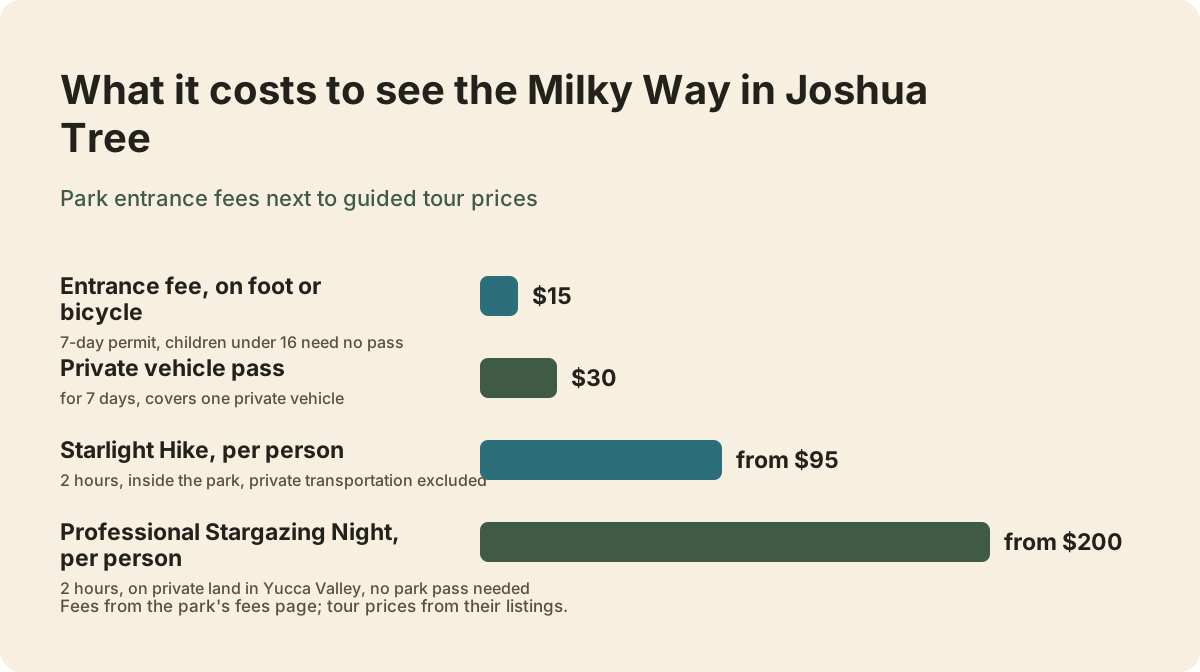
The self-guided route is straightforward. Pay your entrance fee or show a pass, drive to one of the four designated lots after dark, use a red light, wait 20 to 30 minutes for your eyes to adjust, and look south in the core season. The park's per-person entrance fee is $15 for a 7-day permit on foot or by bicycle, children under 16 need no pass, and a private vehicle pass is $30 for 7 days, per the park's fees page. Rangers lead free night-sky and astronomy programs at various points in the year, and those need no reservation, only checking the park's calendar or bulletin boards.
What a tour buys you is the removal of every decision above. The Professional Stargazing Night, from $200 per person for 2 hours, meets in the Yucca Valley area and includes an astronomer, telescopes, astro-binoculars, blankets, lounge seating, and coffee or tea, and it runs on private land just outside the park in Yucca Valley, not inside the national park, so no park pass is needed and no park entry is implied. It is rated 4.9 across 179 reviews. The Stargazing Experience, from $189 per person for 2 hours, also meets near Joshua Tree and also runs on private land outside the park; it has a small review pool of 11 reviews, too few for a star claim.
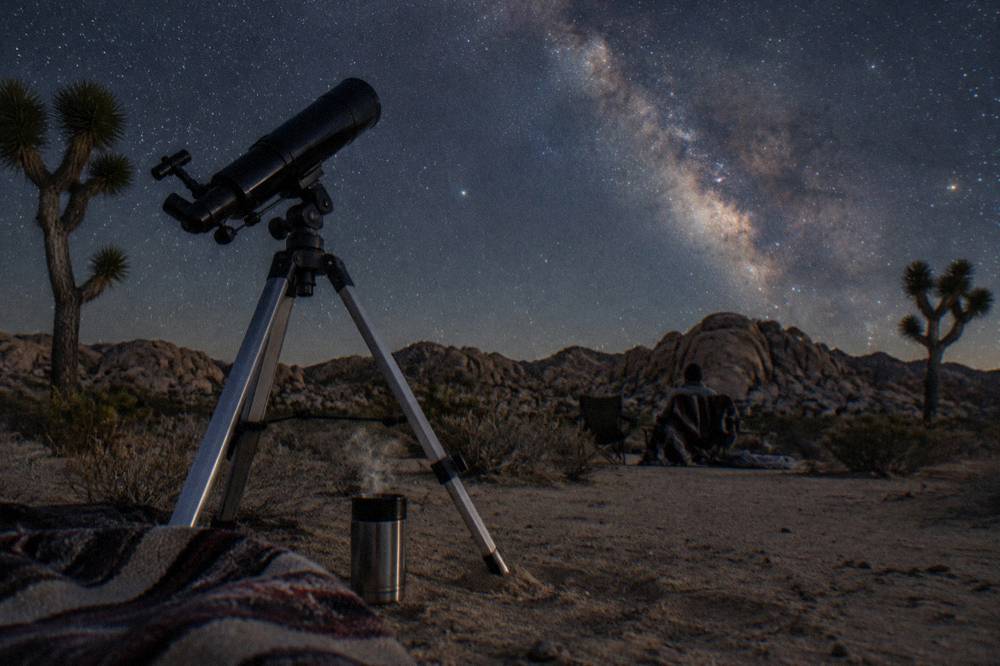
The in-park guided option is the Starlight Hike, from $95 per person for 2 hours, which includes access to a trailhead inside Joshua Tree National Park and therefore pairs with the park's own entrance rules, private transportation excluded. It has no reviews on the listing, so we state that plainly rather than reaching for a rating claim. For visitors coming from Los Angeles who want the whole day handled, the Sunset Stargazing Day Trip from LA runs 10 to 12 hours from $299 per person and includes the park entrance fee.
How Does The Moon Affect Milky Way Viewing?
A bright moon is the single biggest killer of Milky Way views, which is why the park's stargazing guidance says to avoid it: bright moonlight reduces the stars you see. The galactic core's faint outer structure is especially vulnerable, so a gibbous or full moon can erase it even in a Silver Tier dark sky park. Plan around moonless nights.
This is the rule that outranks everything else in this guide. You can have the right month, the right hour, the darkest corner of the park, and a cloudless sky, and a moon more than a slim crescent will still cut the Milky Way down to a faint smear. The park's page treats moon avoidance as a first-order planning step, right alongside red lights and layers. The practical version: check a moon-phase and Milky Way app before you commit to a date, and treat any night within a few days of a full moon as a night for planets and bright stars instead.
The moon's effect is not subtle because the galactic core is not bright in the way planets are. The dense star clouds are an aggregate of countless faint points, and even moderate moonlight raises the sky background enough to swallow them. The dark nebulae lanes that make the core photogenic, the dust silhouettes, are the first thing to vanish. Eyes need 20 to 30 minutes of full dark adaptation to see the structure well, and that adaptation is exactly what moonlight and white flashlights destroy.
| Moon condition | Effect on the Milky Way | Planning response |
|---|---|---|
| New moon | Darkest possible sky, full core structure | Best nights for the galactic core |
| Thin crescent | Minor brightening, core still strong | Very good, sets early or rises late |
| Quarter moon | Sky noticeably brightened, faint detail lost | Acceptable for bright objects, weak for the core |
| Gibbous to full moon | Core structure largely erased | Shift to telescope targets or a different night |
The interaction between moon and season is why apps matter more than calendars. The core season spans months, and within it, moonless windows recur roughly monthly. A printed list of dates goes stale the moment it is published, and the park's own pages do not issue one, they state the rule and leave the arithmetic to the visitor. The same logic applies to sunset and moonset times: they shift by minutes every day, so check current figures rather than relying on a blog post's table.
What Gear Do You Need For Milky Way Photography?
For eyes-only viewing, the list is short: red light, layers, a chair and water, exactly what the park's stargazing page prescribes. For photography, you need a camera with manual long exposure, a fast wide lens, a sturdy tripod, and patience with the park's one photography-specific rule: "paint with light" is not permitted, so no artificial illumination of the landscape.
Start with the viewing kit, because it applies to everyone. Red lights only, since eyes need 20 to 30 minutes to adapt and one white headlamp resets the clock for a whole parking lot. The park asks night visitors at the designated areas to stay within 20 ft of the vehicle, so a folding chair turns a lot into a camp. Desert nights drop fast: spring and fall lows sit around 50 F, and winter nights fall near or below freezing, so layers are not optional even after a warm day.
For the camera, the standard Milky Way kit applies: a lens in the 14 to 24 mm range with a wide aperture, exposures long enough to gather the core, and a tripod solid enough to hold still through them. Focusing is the usual failure point, since the autofocus systems that work all day have nothing to lock onto in a featureless dark sky, so manual focus on a bright star or distant light is the working method. Battery life collapses in cold, so spares live in a pocket, not a bag.
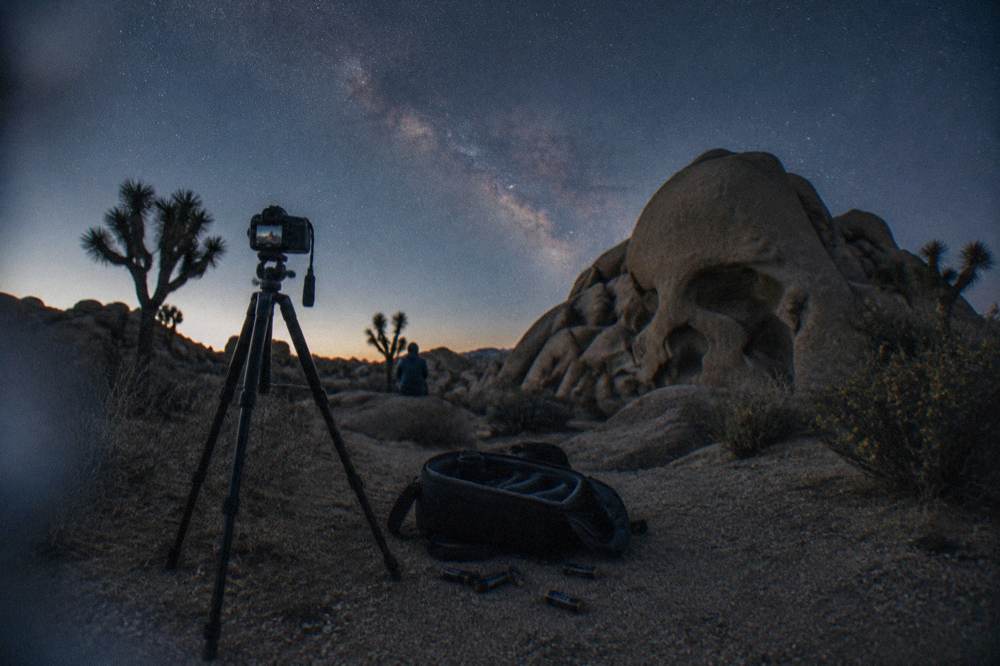
The one rule specific to photographers: the park's stargazing page states that "paint with light" is not permitted for night photography. That is the technique of sweeping a flashlight across the foreground during a long exposure to light up rocks or trees, and in this park it is off the table. Silhouettes are the aesthetic here anyway, and the rule protects the dark adaptation of everyone else at the lot. Drones, worth noting for anyone tempted to get creative, are prohibited in the park outright.
| Item | Purpose | Park-specific note |
|---|---|---|
| Red light | Preserves night vision, 20-30 min adaptation | Park asks for red light only |
| Layers and hat | Desert nights near or below freezing in winter | Lows around 50 F in spring and fall |
| Chair and water | Long stationary sessions at a lot | Stay within 20 ft of your vehicle |
| Tripod and fast wide lens | Long exposures of the core | No "paint with light" on foregrounds |
| Spare camera batteries | Cold drains batteries fast | No stores or water inside the park |
What Are The Park's Night Sky Rules?
The after-dark rules are a short list: red lights only, stay awake and within 20 ft of your vehicle at the designated stargazing areas, no "paint with light" photography, drones prohibited park-wide, and pets confined to roads, parking areas and campgrounds, never on trails. The park is open 24 hours, and no reservation is needed to enter at night.
The 20 ft rule deserves a word of explanation because it reads oddly until you picture the scene. The four designated areas are parking lots, and the park wants people near their cars so that drivers arriving or leaving can see them, and so nobody wanders off pavement into terrain in full darkness. It is not a restriction on where the sky is visible, it is a restriction on where the people are. Staying awake is the other half: sleeping overnight at a day-use lot is not the same as stargazing from it.
The pet rule catches night visitors too. Pets are not allowed on trails, in the backcountry or in park buildings, even carried, and must stay within 100 ft of roads, parking areas and campgrounds on a leash of 6 ft or less. A dog at a stargazing lot is legal in principle, but a dog that barks at every jackrabbit ruins the quiet for everyone, and the park's pets page is the source for the full terms. Fires are only permitted in designated fire rings at campgrounds, and the annual campfire ban runs June 15 to October 1, so a night session in the warm core season is a no-fire affair.
The 24-hour access is the rule that makes spontaneous Milky Way nights possible. The park publishes that it is open 24 hours a day, 7 days a week, 365 days a year, that no timed-entry or advance reservation is needed to enter, and that you are welcome to drive in and out at any time. When the fee booth is closed, you may be asked to show a pass or pay on the way out. For the full set of rules, the park's first-time visitor page is the primary source.
What Does The Weather Do To Milky Way Season?
Summer brings the core's best nights but also the year's worst hazards: daytime heat above 100 F, monsoon storms and flash-flood risk in washes, plus the annual campfire ban from June 15 to October 1. Spring and fall offer mild nights near 50 F with wind risk, and winter brings freezing nights, occasional snow, and the earliest sunsets for evening sessions.
The seasonal trade-offs are the part first-time visitors underestimate. Summer gives the galactic core its best window, and it gives the desert its most dangerous conditions. The park's heat safety guidance says to check forecasts, carry ample water, avoid midday activity and know the signs of heat illness, and the monsoon pattern means a storm tens of miles away can send water down a wash you are standing in. The 49 Palms Oasis Trail is closed June 1 to September 30 every year for exactly this reason, which tells you how the park itself rates summer heat (see Summer In Joshua Tree).
Spring and fall are the compromise most photographers settle on: average highs around 85 F, lows near 50 F, and a core season that overlaps with both. The park lists its crowded periods as holidays, weekends from October to May, and spring break from March to mid-April, which matters at the small designated lots, where a dozen tripods fill a parking area fast. Winter trades comfort for schedule: nights near or below freezing, occasional snow on the higher ground, but the Milky Way's outer band is still there and the crowds are gone.
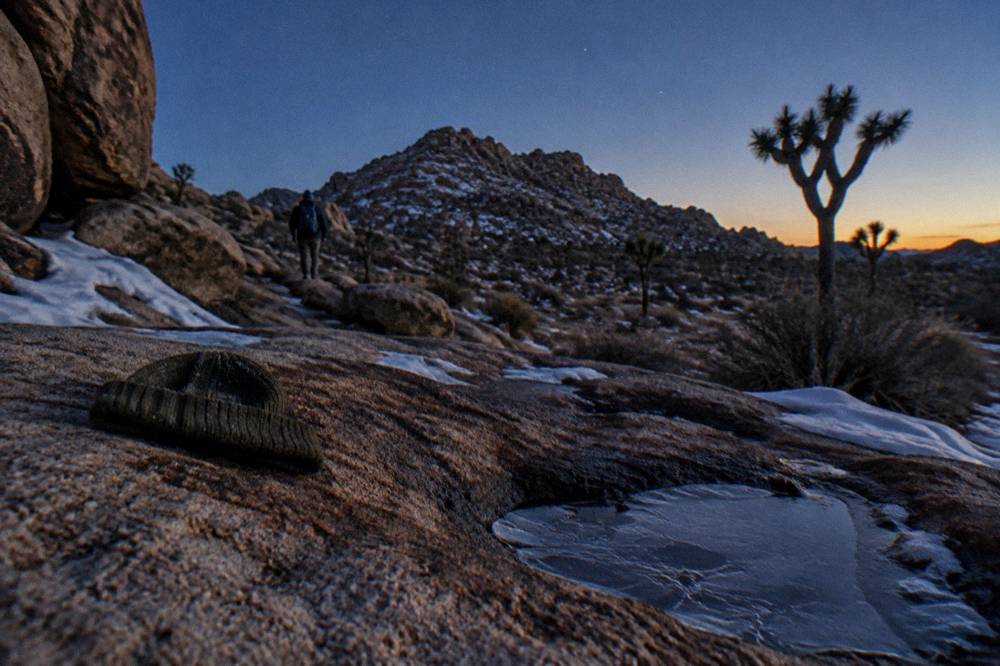
For current conditions, the park's conditions page is the live source for weather, road and trail status, and it is what any honest guide should point to rather than quoting a forecast. The durable facts are the seasonal ones above; anything about a specific week belongs to the park's own alerts, not to an article.
| Season | Typical night conditions | Trade-offs for Milky Way viewing |
|---|---|---|
| Summer | Lows near 75 F, monsoon storm risk | Best core window, worst heat and flood hazard, campfire ban |
| Spring | Lows around 50 F, wind possible | Comfortable nights, spring-break crowds March to mid-April |
| Fall | Lows around 50 F, settling weather | Comfortable, popular weekends October to May begin |
| Winter | Near or below freezing, possible snow | Fewest people, freezing gear and batteries, early darkness |
Which Guided Night Tours Fit Milky Way Season?
The night-tour roster splits into three shapes: private-land stargazing sessions outside the park in Yucca Valley, in-park night hiking, and full day trips from Los Angeles that end under the stars. The Stargazing Experience and Professional Stargazing Night run on private land, not inside the park, while the Starlight Hike and the LA sunset trip work inside it.
The private-land distinction matters for planning, so it is worth stating twice: the Professional Stargazing Night and the Stargazing Experience both run on private land just outside the park in Yucca Valley. No park entrance, no park pass, no 20 ft rule. The Professional Stargazing Night, from $200 per person for 2 hours, is rated 4.9 across 179 reviews and includes an astronomer, telescopes, astro-binoculars, blankets, lounge seating, and coffee or tea, with transportation and restrooms excluded. A guest on it, James, called the crew "very knowledgeable and very nice."
The Stargazing Experience, from $189 per person for 2 hours, is the related tour on this page's planning, and it makes a sensible pairing with a Milky Way night: Check availability alongside the details in our Joshua Tree stargazing tours roundup. Its review pool is small, 11 reviews, too few for a star claim, so we describe it by what the listing includes rather than by a rating.
Inside the park, the Starlight Hike, from $95 per person for 2 hours, includes access to a trailhead inside Joshua Tree National Park and excludes private transportation, so you drive yourself to the meeting point in the Joshua Tree area. It carries no reviews on the listing, which we state plainly. From Los Angeles, the Sunset Stargazing Day Trip runs 10 to 12 hours from $299 per person with the park entrance fee included, which removes both the driving and the pass question in one booking.
For visitors who want to build their own night instead, the Joshua Tree stargazing guide covers the self-guided basics in depth, and our best time to visit Joshua Tree guide handles the seasonal decision across the whole park. If your question is narrower, the blog piece on what month is best for stargazing in Joshua Tree digs into the monthly trade-offs.
How Do You Plan A Milky Way Night Around The Park's Rules?
Pick a moonless night in the core season, pick a designated lot or the darker southeast corner, carry red light, layers, water and a chair, and stay within 20 ft of your vehicle. Check the park's conditions page for weather and closures before you drive, since trail, road and weather status changes and no article can hold it.
The planning sequence that works looks like this. First, the moon: open a moon-phase and Milky Way app and rule out any night near a full moon, per the park's own guidance to avoid bright moonlight. Second, the season: confirm the galactic core is actually rising in dark hours for your dates, again from the app rather than a printed table. Third, the site: one of the four designated lots for convenience, or Cottonwood Campground and the Pinto Basin Road pullouts for darkness. Fourth, the conditions check on the park's own pages, the day you go.
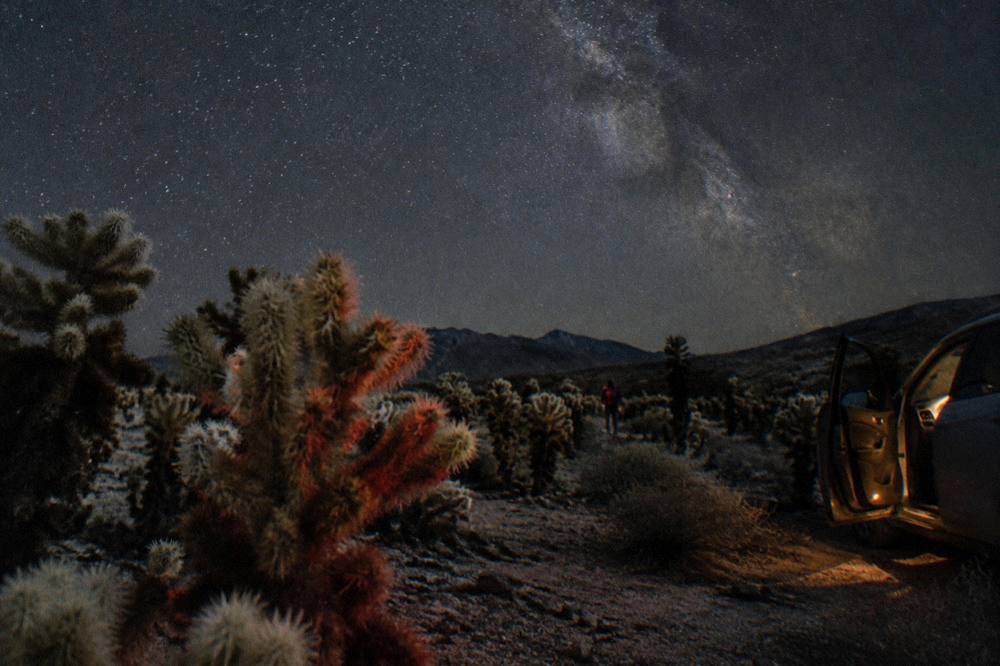
Fifth, the honest self-assessment. If that sequence sounds like work, it is, and that is the case for the guided options above: someone who watches the sky for a living makes the moon call, picks the site, brings the telescopes and the blankets, and adjusts when the weather turns. If the sequence sounds like the fun part, the park's lots are waiting, and the only cost beyond your entrance pass is the discipline to keep your flashlight red.
Whatever you choose, the destination earns the effort. A Silver Tier International Dark Sky Park within a few hours of Los Angeles is a scarce thing, and the park's own pages treat the night sky as one of its headline resources, with designated areas, published etiquette and free ranger astronomy programs through the year. The Milky Way season will come around again if you miss it, but a moonless summer night in the high desert does not come around often, and it does not wait for anyone's planning. This site, Joshua Tree Park Tours, keeps the full roster of night options in one place for exactly that night.
Common Questions About Milky Way Season In Joshua Tree
When Is Milky Way Season In Joshua Tree?
The galactic core is at its best on moonless summer nights, per the park's stargazing guidance. The rest of the Milky Way is faintly visible year-round on dark, moonless nights, but the bright core section follows the warm months. Check a moon-phase and Milky Way app for the specific nights.
Can You See The Milky Way With The Naked Eye In Joshua Tree?
Yes. On a moonless night in an International Dark Sky Park, the Milky Way's band and the galactic core are visible without any equipment. Give your eyes 20 to 30 minutes to adapt, use a red light only, and avoid looking at bright screens or white flashlights.
Where Is The Darkest Place To Stargaze In Joshua Tree?
The park names Cottonwood Campground as the darkest of its campgrounds and describes the Pinto Basin Road pullouts between the Cholla Cactus Garden and Cottonwood as having the least traffic and darkest skies. The four designated stargazing lots, Quail Springs, Hidden Valley, Cap Rock and Ryan Mountain, are the convenient official options.
Do The Stargazing Tours Go Inside The National Park?
The Professional Stargazing Night and the Stargazing Experience run on private land just outside the park in Yucca Valley, so no park pass is needed. The Starlight Hike includes access to a trailhead inside the park, and the Sunset Stargazing Day Trip from Los Angeles includes the park entrance fee.
Does The Moon Really Ruin Milky Way Viewing?
Yes. The park's own stargazing page says to avoid the moon because bright moonlight reduces the stars you see. The galactic core is an aggregate of faint light, so a gibbous or full moon raises the sky background enough to erase its structure even from a dark site.
Is Night Photography Allowed In Joshua Tree?
Yes, with one specific restriction: the park states that "paint with light" is not permitted for night photography, so no illuminating the foreground with flashlights during long exposures. Drones are prohibited park-wide, and night visitors are asked to use red lights only and stay within 20 ft of their vehicle at the designated stargazing areas.